
What's Happening?
The growing issue of space debris has been underscored by a recent incident involving China's Shenzhou-20 spacecraft. On November 5, astronauts preparing to undock from the Chinese space station discovered
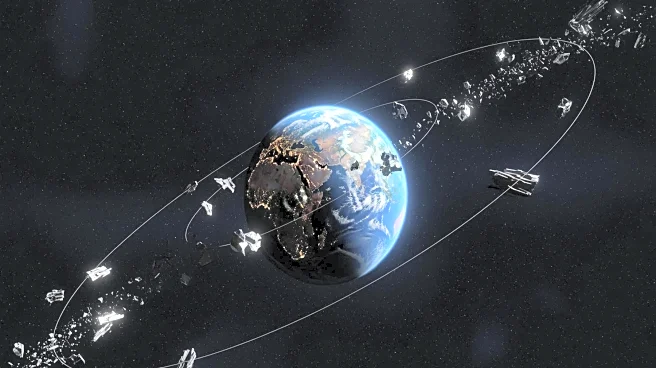
small cracks in their spacecraft's window, attributed to impacts from space debris. This incident rendered the spacecraft unsuitable for a safe return, prompting China to launch an unmanned Shenzhou-22 for cargo purposes and safely return astronauts aboard Shenzhou-21. The problem of space debris, consisting of millions of fragments from rocket explosions, abandoned satellites, and broken equipment, is exacerbated by deliberate destruction during anti-satellite weapons testing. Experts warn that the risk of collisions is increasing, leading to more debris, a phenomenon known as Kessler syndrome.
Why It's Important?
The incident with Shenzhou-20 highlights the escalating dangers posed by space debris, which threatens the safety of space missions and the integrity of spacecraft. As the amount of debris increases, the risk of collisions grows, potentially leading to catastrophic failures and loss of life. This situation calls for improved tracking, accountability, and international cooperation to manage orbital debris effectively. The need for common standards for orbital awareness and certification programs to reduce risk is becoming increasingly urgent. The incident serves as a wake-up call for the global community to address the issue of space debris with greater urgency and collaboration.
What's Next?
The international community is urged to adopt auditable management practices, including interoperable knowledge systems and certification programs for missions that aim to reduce risk. Experts suggest that missions and governance mechanisms should be designed to regenerate knowledge at the rate it decays, ensuring safety margins are maintained. The incident with Shenzhou-20 may push countries and companies to prioritize data accuracy and transparency as part of safety engineering, potentially leading to new policies and agreements on space debris management.
Beyond the Headlines
The Shenzhou-20 incident highlights the need for 'epistemic humility' in space exploration, acknowledging unknowns and adjusting plans accordingly. This approach should become standard practice to ensure the safety of space missions. The event also underscores the importance of international cooperation in establishing common standards for tracking and managing space debris. As space exploration continues to expand, the ethical and legal dimensions of debris management will become increasingly significant, requiring collaborative efforts to safeguard the future of space travel.