



What's Happening?
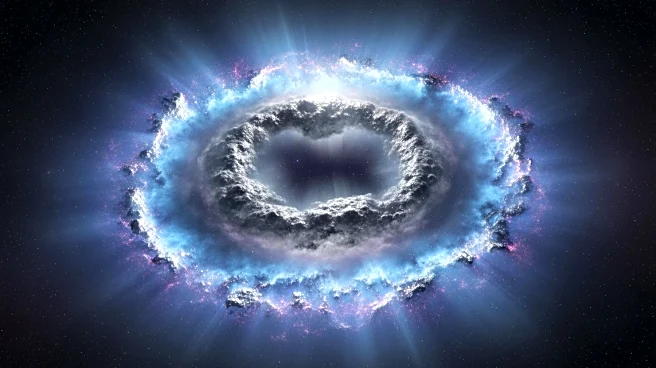
A team of European astronomers, led by researchers from University College London and Cardiff University, has discovered a massive, bar-shaped cloud of iron within the Ring Nebula. This structure, which is about 500 times the length of Pluto's orbit and has a mass comparable
to Mars, was identified using the WHT Enhanced Area Velocity Explorer (WEAVE) on the William Herschel Telescope. The discovery was reported in the Monthly Notices of the Royal Astronomical Society. The iron cloud is located deep within the nebula's inner region, which is known for its elliptical shape. The origin of this iron structure remains unclear, with hypotheses ranging from nebular ejection processes to the vaporization of a rocky planet. Further high-resolution spectral studies are planned to better understand its formation and chemical composition.
Why It's Important?
The discovery of the iron cloud within the Ring Nebula is significant as it could provide new insights into the processes occurring in dying stars and the formation of nebulae. Understanding the origin and composition of such structures can enhance knowledge about stellar evolution and the lifecycle of stars. This finding also demonstrates the capabilities of the WEAVE instrument, which allows for detailed spectral analysis across the nebula. The research could potentially reveal whether similar structures exist in other nebulae, contributing to a broader understanding of cosmic phenomena. The implications of this discovery extend to the fields of astrophysics and cosmology, offering a new perspective on the material ejected by stars and the potential for discovering new cosmic structures.
What's Next?
The research team plans to conduct follow-up studies using WEAVE's LIFU at higher spectral resolution to gather more detailed data on the iron cloud's formation and composition. These observations aim to determine whether other elements coexist with the iron, which could help identify the correct model for its origin. WEAVE is set to conduct eight major surveys over the next five years, which will include studying additional ionized nebulae across the northern Milky Way. The team hopes to discover more examples of similar structures, which would aid in understanding the prevalence and origins of such phenomena in the universe.