
What's Happening?
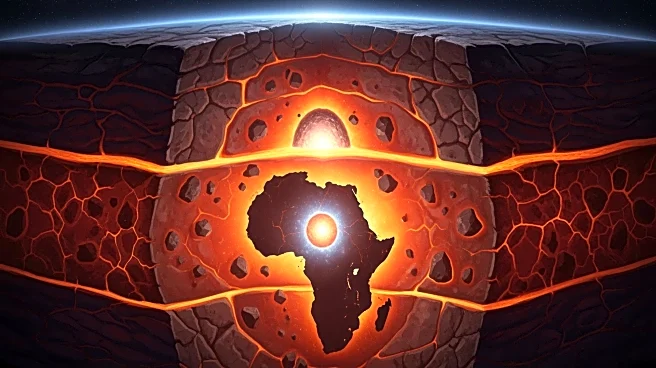
Scientists have discovered two colossal structures beneath Africa, which may be remnants of an ancient planet named Theia. These structures, known as large low-shear-velocity provinces (LLSVPs), were identified
through seismic wave patterns that slow down when passing through these formations, indicating a distinct composition. The leading theory suggests these are fragments of Theia, a hypothetical planet believed to have collided with Earth billions of years ago, contributing to the formation of the Moon. The structures are thought to be chemically distinct and denser than the surrounding mantle, possibly influencing Earth's surface through mantle plumes that drive volcanic activity.
Why It's Important?
The discovery of these structures could reshape our understanding of Earth's geological history and the formation of the Moon. If the theory holds, it suggests that remnants of Theia have been preserved within Earth's mantle for over 4.5 billion years. This could provide insights into the processes that shaped the early Earth and the Moon. Additionally, the presence of these structures may influence volcanic activity and tectonic processes, impacting geological features and potentially affecting climate and ecosystems over geological timescales.
What's Next?
Further research is needed to confirm the Theia-origin model and understand the full implications of these structures. Scientists may conduct more detailed seismic studies and simulations to explore the chemical composition and dynamics of the LLSVPs. Understanding these structures could lead to new insights into Earth's interior and its geological processes, potentially influencing theories about planetary formation and evolution.