









What's Happening?
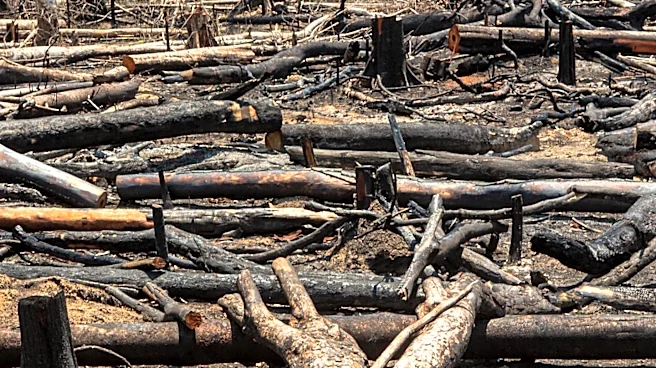
A new study reported by Mongabay reveals that criminal groups are controlling significant land areas near the BR-319 highway in the Brazilian Amazon. These groups are linked to illegal deforestation, gold mining, land grabbing, and cattle ranching. The study,
led by University of São Paulo researcher Lucas Ferrante, documented a sharp increase in deforestation after 2015, following the authorization of road maintenance work by then-president Dilma Rousseff. The situation intensified under President Jair Bolsonaro, whose promise to pave the road spurred land speculation and the conversion of forests into pastureland. Insufficient state oversight has created a favorable environment for organized crime, with drug trafficking and environmental crimes often sharing routes and financial flows. Cattle ranching is frequently used to launder proceeds from these illicit activities.
Why It's Important?
The control of land by criminal groups near the BR-319 highway poses a significant threat to the Amazon rainforest and its biodiversity. The acceleration of deforestation, driven by illegal activities, pushes the Amazon closer to its ecological tipping point, with potential irreversible consequences for global climate regulation and regional ecosystems. The study highlights a critical governance failure, where the lack of effective state oversight allows organized crime to flourish, undermining environmental protection efforts. The intertwining of drug trafficking, illegal mining, and environmental crimes creates a complex challenge for law enforcement and conservationists. Furthermore, the use of cattle ranching for money laundering indicates a sophisticated criminal infrastructure that exploits economic sectors, making it harder to track and combat illegal operations.
What's Next?
Brazilian President Luiz Inácio Lula da Silva has initiated the advancement of work on BR-319, utilizing a new legal loophole to bypass environmental licensing requirements. This move is met with concern from environmentalists who fear it could accelerate deforestation and push the Amazon past its tipping point. The study suggests that at least 28 checkpoints would be necessary to inspect transport on the numerous illegal secondary roads that already exceed the length of BR-319 by six times. While Lula’s administration has created four sustainable development reserves covering 668,000 hectares near the highway and plans to establish checkpoints for animal movement, the study calls for authorities to review or revoke permits and regulatory decisions that facilitate further road improvements. The ongoing tension between infrastructure development and environmental protection will likely continue.
Beyond the Headlines
The situation around the BR-319 highway exposes deeper systemic issues within Brazil, including the challenges of governance, corruption, and the economic pressures driving deforestation. The study's findings suggest that environmental degradation is not merely a consequence of individual actions but is often orchestrated by organized criminal networks. This raises ethical questions about the responsibility of governments to protect natural resources and indigenous communities from such exploitation. The bypassing of environmental licensing requirements for infrastructure projects also highlights a broader debate about balancing economic development with ecological preservation. The long-term implications include not only environmental catastrophe but also the erosion of the rule of law and the empowerment of criminal elements, potentially leading to increased social instability and violence in the region.