
What's Happening?
The United States has announced the initiation of the second phase of President Trump's 20-point peace plan for Gaza. This phase involves the establishment of a committee of Palestinian technocrats tasked
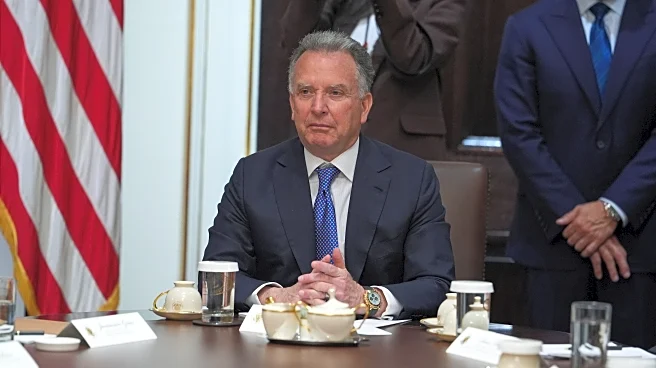
with administering the Gaza Strip. The plan aims to achieve full demilitarization and reconstruction of the region. White House Middle East envoy Steve Witkoff highlighted that the committee's formation is a significant step towards stabilizing Gaza and improving humanitarian conditions. The committee, composed of 15 members, will be led by Ali Abdel Hamid Shaath, a civil engineer from Gaza. The U.S. has emphasized the importance of Hamas disarming and returning the last Israeli hostage, although details on achieving these goals remain unspecified.
Why It's Important?
The launch of this phase is crucial as it represents a concerted effort to bring stability and reconstruction to Gaza, a region long plagued by conflict. The involvement of a technocratic committee suggests a shift towards governance focused on practical administration and service provision, potentially reducing the influence of militant groups. This development could lead to improved living conditions for Palestinians in Gaza and foster a more stable geopolitical environment in the Middle East. However, the success of this initiative hinges on the cooperation of various stakeholders, including Hamas and Israel, and their willingness to adhere to the terms of the peace plan.
What's Next?
The next steps involve the committee assuming its responsibilities in Gaza, with a focus on managing daily life and providing essential services. The U.S. plans to engage in further discussions with Hamas regarding demilitarization and an amnesty program for militants. The international community, including countries like Egypt, Qatar, and Turkey, will continue to play a role in supporting the peace process. The U.S. has also indicated that security in Gaza will be bolstered by an International Stabilization Force, although details on its composition are yet to be finalized. The success of these efforts will be closely monitored by regional and international stakeholders.