
What's Happening?
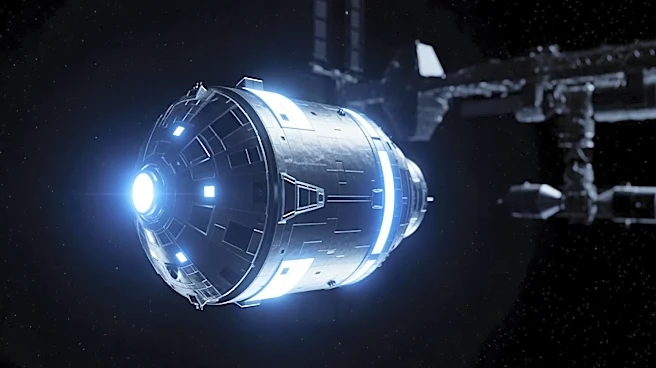
The International Space Station (ISS) has commenced new scientific experiments following the delivery of approximately 6,500 pounds of cargo by a SpaceX Dragon spacecraft on May 17. The Expedition 74 crew,
including NASA flight engineer Jack Hathaway, began unloading the supplies and initiating research activities. Key experiments involve studying the effects of microgravity on blood-making cells, with NASA astronaut Jessica Meir preparing samples in the Kibo laboratory module. The research aims to understand how weightlessness impacts blood clotting and immune function. Additionally, NASA astronaut Chris Williams activated student-designed experiments involving biological and material samples. The crew is also preparing for an upcoming spacewalk, with Roscosmos cosmonauts Sergey Kud-Sverchkov and Sergey Mikaev readying tools and spacesuits.
Why It's Important?
The experiments conducted aboard the ISS are crucial for advancing scientific knowledge and understanding the effects of space travel on human biology. The research on blood platelets could have significant implications for long-duration space missions, such as those planned for Mars, by addressing potential health risks associated with microgravity. Furthermore, the student-designed experiments foster educational engagement and inspire future generations to pursue careers in science, technology, engineering, and mathematics (STEM). The upcoming spacewalk preparations highlight the ongoing international collaboration in space exploration, with contributions from NASA and Roscosmos enhancing the mission's success.
What's Next?
The ISS crew is preparing for a spacewalk scheduled for the end of the month, which will involve Roscosmos cosmonauts Sergey Kud-Sverchkov and Sergey Mikaev. This activity will focus on maintaining and upgrading the station's systems, ensuring its continued operation and support for scientific research. The results from the current experiments will be analyzed to provide insights into the biological effects of space travel, potentially influencing future mission planning and astronaut health protocols. Continued international cooperation and successful execution of these missions will pave the way for more ambitious space exploration endeavors.