



What's Happening?
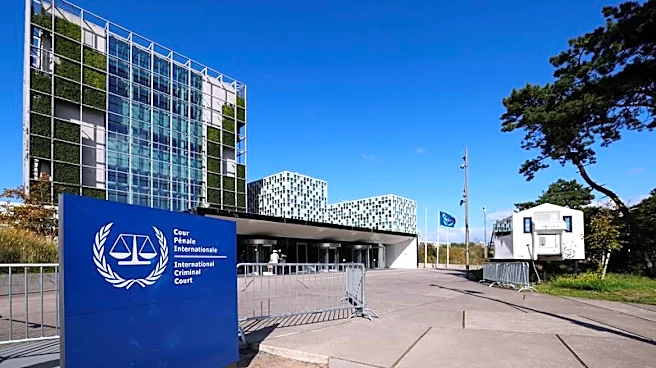
The Trump administration has imposed sanctions on International Criminal Court (ICC) president Tomoko Akane and senior trial lawyer Abdoulaye Seye. These sanctions, announced by the State Department, freeze any assets the individuals hold in U.S. jurisdictions
or that interact with the U.S. financial system. This action is part of a wider effort by the Trump administration to target the ICC, which it accuses of overstepping its mandate by investigating and seeking to prosecute officials from non-member countries, including the United States and Israel. The ICC has condemned these sanctions as a 'flagrant attack' on its independence, asserting its commitment to pursuing justice for atrocities globally. The Trump administration has previously sanctioned nine of the ICC's 18 judges, both deputy prosecutors, its former chief prosecutor, and another prosecution office staffer.
Why It's Important?
These sanctions carry significant implications for international law and the functioning of global institutions. By targeting key officials, the U.S. is directly challenging the ICC's authority and its ability to operate independently. The move could deter other nations from cooperating with the ICC, potentially weakening its capacity to address war crimes, genocide, and crimes against humanity. The U.S. stance, articulated by Secretary of State Marco Rubio, frames the ICC as a 'corrupt and fatally politicized supranational court' that has 'maliciously abused its authority.' This perspective underscores a fundamental disagreement between the U.S. and many international partners regarding the scope and legitimacy of international legal bodies. The sanctions also impact the personal lives of court officials, restricting their travel and access to basic financial services, as exemplified by Canadian judge Kimberly Prost, who lost access to credit cards and services like Amazon's Alexa after being sanctioned.
What's Next?
The ICC has vowed to continue its mandate with independence and impartiality despite the sanctions. The Trump administration has indicated it will continue its 'sweeping campaign to dismantle the threat posed by the International Criminal Court to U.S. sovereignty,' which includes pressuring the court's 125 member states to withdraw and sanctioning organizations that collaborate with the court. This pressure has already seen Venezuela and Chad announce plans to leave the court, adding to the five countries that have pulled out in the past year. The court's oversight body, the Assembly of States Parties, views the sanctions as an 'escalation' that could undermine ongoing investigations and global efforts to ensure justice. Legal challenges are also underway, with Human Rights Watch and other advocacy groups suing the Trump administration in a New York court to contest its campaign against the ICC.
Beyond the Headlines
The U.S. sanctions against ICC officials highlight a deeper tension between national sovereignty and international legal accountability. The Trump administration's actions reflect a 'America First' approach that prioritizes U.S. interests and jurisdiction over multilateral institutions. This could set a precedent for other powerful nations to disregard international legal frameworks when they perceive them as infringing on their sovereignty. The ethical dimension of these sanctions is also significant, as they target individuals performing judicial duties, potentially chilling the willingness of legal professionals to serve in international bodies. The long-term impact could be a fragmentation of the international legal order, making it more challenging to hold perpetrators of grave crimes accountable and undermining the principle of universal justice. The response from allies like Japan, the Netherlands, and Germany, who have expressed support for the ICC, indicates a potential diplomatic rift over the future of international justice.