

What's Happening?
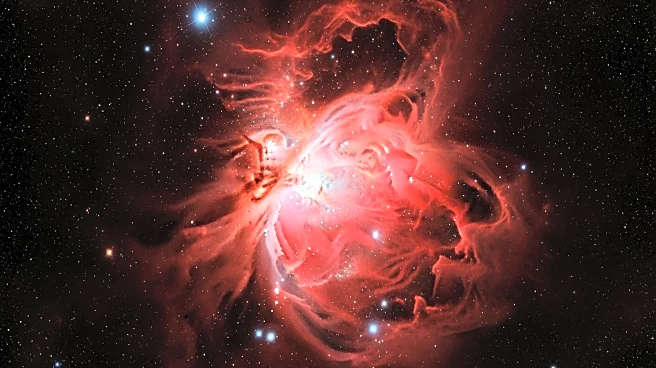
NASA's James Webb Space Telescope (JWST) has captured unprecedented details of the Red Spider Nebula using its Near-InfraRed Camera (NIRCam). The new imagery reveals the nebula's outstretched lobes, which form the 'legs' of the spider, in full extent.
These lobes are shown as closed, bubble-like structures extending about 3 light-years, filled with outflowing gas from the nebula's center over thousands of years. The JWST, launched in 2021, is the world's premier space science observatory, capable of detecting infrared radiation across the universe. The high-resolution imagery provided by NIRCam will aid in a variety of analyses, enhancing our understanding of the universe.
Why It's Important?
The James Webb Space Telescope's ability to capture detailed images of celestial bodies like the Red Spider Nebula represents a significant advancement in space exploration and astronomy. This development allows scientists to study the formation and evolution of nebulae with greater precision, potentially leading to new insights into the lifecycle of stars and the dynamics of interstellar matter. The JWST's findings could influence future research and exploration strategies, impacting how space agencies prioritize missions and allocate resources. Additionally, these discoveries contribute to the broader scientific community's understanding of the universe, fostering educational and public interest in space science.