







What's Happening?
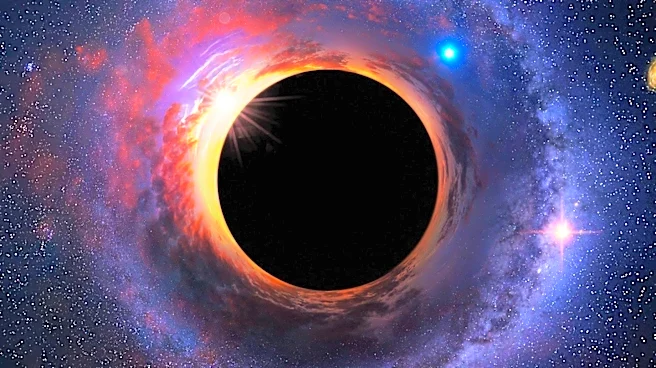
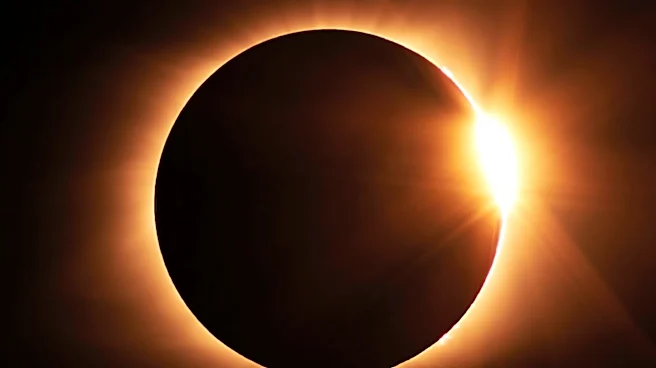
Solar eclipses have fascinated humanity for millennia, with records dating back to the 13th century BC. These celestial events have been documented in various forms, from ancient petroglyphs to modern photography. Notably, the 1919 solar eclipse provided
crucial evidence for Albert Einstein's theory of general relativity, as astronomer Arthur Eddington's observations confirmed the bending of light by the sun's gravity. Over time, eclipses have been captured in increasingly detailed images, enhancing our understanding of the sun's corona and its mysterious properties. These events continue to be a source of scientific inquiry and public interest.
Why It's Important?
Solar eclipses offer unique opportunities for scientific exploration, particularly in understanding the sun's corona, which is significantly hotter than its surface. The 1919 eclipse was pivotal in confirming general relativity, reshaping our understanding of physics and the universe. Eclipses also provide insights into solar activity, which can impact satellite operations and power grids on Earth. Additionally, studying animal behavior during eclipses helps scientists understand how different species perceive and react to sudden environmental changes. These events bridge the gap between historical curiosity and modern scientific research, highlighting the enduring human quest for knowledge.
Beyond the Headlines
Beyond their scientific significance, solar eclipses have cultural and historical importance, influencing art, religion, and folklore across civilizations. They serve as reminders of humanity's long-standing fascination with the cosmos and our place within it. As technology advances, our ability to study these phenomena will continue to grow, potentially unlocking new mysteries of the universe. Eclipses also foster public engagement with science, inspiring future generations of astronomers and researchers. The interplay between historical documentation and modern technology exemplifies the evolution of scientific inquiry and the enduring allure of celestial events.