


What's Happening?
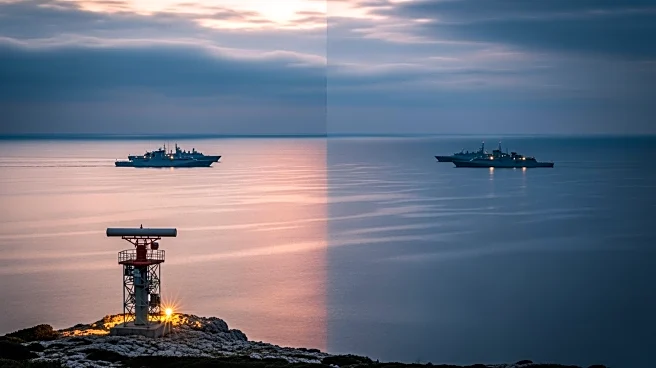
China has expelled a Philippine aircraft and multiple vessels from the waters near Sabina Shoal in the South China Sea, escalating ongoing territorial disputes in the region. The Chinese military issued strong warnings and claimed to have 'expelled' a Philippine aircraft that
allegedly invaded airspace above the Scarborough Shoal. The Chinese Coast Guard accused Philippine vessels of entering the waters near Sabina Shoal to provoke incidents, leading to their expulsion. These actions are part of a series of confrontations in the strategic waterway, which China claims almost entirely, overlapping with the exclusive economic zones of several Southeast Asian countries. Despite a 2016 ruling by the Permanent Court of Arbitration in The Hague, which stated that China's claims were not supported by international law, Beijing continues to assert its dominance in the region.
Why It's Important?
The expulsion of Philippine aircraft and vessels by China highlights the ongoing geopolitical tensions in the South China Sea, a critical maritime region for international trade and military strategy. The area is rich in resources and holds significant strategic importance, making it a focal point for regional power dynamics. China's assertive actions could strain its relations with neighboring countries and impact regional stability. The United States and other global powers have vested interests in maintaining freedom of navigation in these waters, and such incidents could lead to increased military presence and diplomatic interventions. The situation underscores the broader implications for international maritime law and the balance of power in the Asia-Pacific region.
What's Next?
The incident may prompt diplomatic responses from the Philippines and other affected nations, potentially involving international bodies to address the territorial disputes. The United States and its allies might increase their military presence in the region to counterbalance China's actions. Future confrontations could lead to heightened tensions and necessitate negotiations to prevent escalation. The Philippines may seek to strengthen its maritime capabilities and alliances to safeguard its territorial claims.
Beyond the Headlines
The ongoing disputes in the South China Sea reflect deeper issues of national sovereignty, resource control, and regional influence. China's actions could set precedents for how international maritime disputes are handled, challenging existing legal frameworks. The situation also raises questions about the effectiveness of international arbitration and the enforcement of international law. Long-term, these tensions could influence global trade routes and economic partnerships, as countries reassess their strategic alliances and economic dependencies.