



What's Happening?
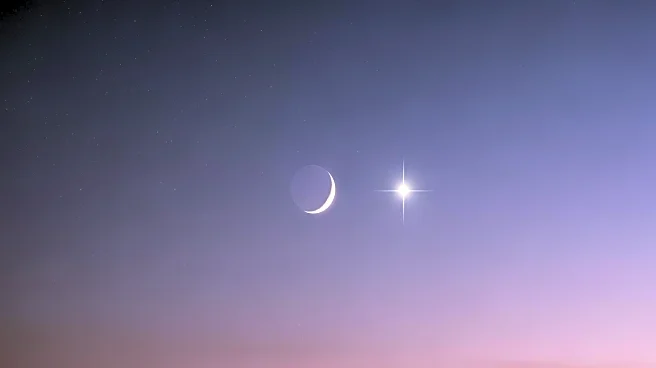
On December 17, 2025, a celestial event is captivating sky watchers as a waning crescent Moon aligns with the bright planet Mercury in the predawn sky. The Moon, illuminated at 6 percent, appears 10 degrees apart from Mercury, which is 82 percent illuminated,
in the southeast sky before sunrise. This alignment occurs in the constellation of Libra, with Mercury positioned in far eastern Scorpius, preparing to transition into Ophiuchus. The event is visible around 6:45 A.M. local time, with the Moon sitting to the upper right of Mercury. By December 18, the Moon's illumination decreases to 2 percent, moving to Mercury's lower right, as Mercury becomes 84 percent illuminated within Ophiuchus. This astronomical occurrence offers a unique opportunity for observers to witness the dynamic interactions within our solar system.
Why It's Important?
This celestial event is significant for both amateur and professional astronomers as it provides a rare opportunity to observe the interactions between the Moon and Mercury. Such alignments allow for the study of planetary motion and the effects of illumination on celestial bodies. For the general public, it offers a chance to engage with astronomy and appreciate the beauty of the night sky. Events like these can inspire interest in space science and foster a greater understanding of our place in the universe. Additionally, the visibility of Mercury, often difficult to observe due to its proximity to the Sun, makes this event particularly noteworthy.
What's Next?
Following this event, observers can look forward to further celestial alignments and phenomena as Mercury continues its journey through the constellations. The transition of Mercury into Ophiuchus marks a period of increased visibility for the planet, offering more opportunities for observation. Astronomers and enthusiasts will continue to monitor these movements, providing insights into planetary behavior and contributing to ongoing research in astronomy. Public interest in such events may lead to increased participation in stargazing activities and educational programs.