
What's Happening?
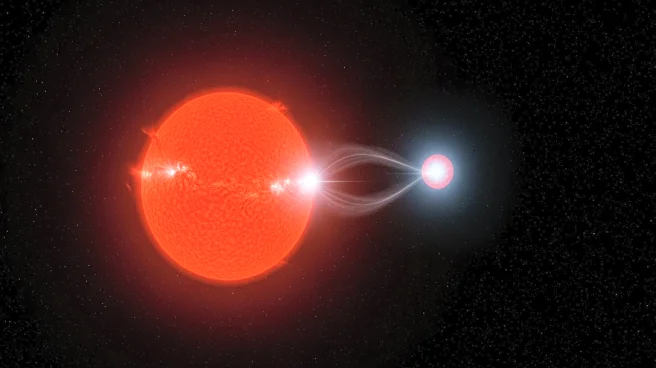
Astronomers have discovered evidence of a hidden companion star orbiting the red supergiant Betelgeuse. Observations over the past eight years have revealed a trail of gas in Betelgeuse's atmosphere, likely
caused by the companion star, nicknamed 'Siwarha.' This discovery helps explain Betelgeuse's six-year brightness variability. Siwarha, too small and faint to be seen directly, is believed to orbit Betelgeuse every six years, affecting the star's luminosity. The findings, published in the Astrophysical Journal, provide new insights into the dynamics of giant stars.
Why It's Important?
The discovery of Siwarha's influence on Betelgeuse offers a unique opportunity to study the evolution of giant stars. Understanding the interaction between Betelgeuse and its companion can shed light on the processes leading to supernovae, as well as the formation and evolution of stars and planets. This research also enhances our knowledge of stellar dynamics, potentially informing studies of other supergiant stars with similar variability patterns.
What's Next?
Astronomers plan to continue monitoring Betelgeuse to refine their understanding of Siwarha's orbit and mass. This will help explain the binary system's evolution and Betelgeuse's rapid rotation. Siwarha is expected to become visible in 2027, providing further opportunities for observation. Researchers are also developing hydrodynamic models to study the wake formed by Siwarha, which will offer deeper insights into the interaction between the two stars.