



What's Happening?
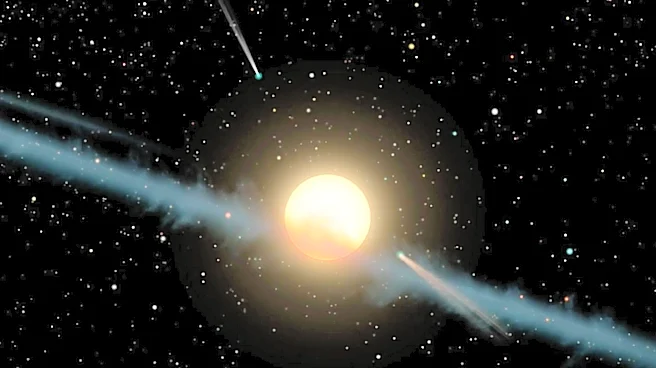
A recent study has provided new insights into the mysterious dimming of Tabby's Star, also known as KIC 8462852. Since 2016, this star has exhibited irregular dimming patterns, sparking various theories, including the possibility of alien megastructures.
The study, led by Cristina Madurga-Favieres from the University of Warwick, utilized data from NASA's Transiting Exoplanet Survey Satellite (TESS) to identify a 21-hour symmetric dip in the star's light. This dip suggests the presence of a companion object, possibly a giant planet or brown dwarf, orbiting the star. The study proposes that this companion's gravity could be responsible for the irregular dimming by flinging comets and debris into orbits around the star.
Why It's Important?
The findings of this study are significant as they offer a plausible explanation for the decade-long mystery surrounding Tabby's Star. Understanding the mechanisms behind the star's dimming can enhance our knowledge of stellar behavior and the dynamics of celestial bodies. This research also highlights the importance of advanced observational technologies, such as TESS, in unraveling astronomical phenomena. The potential discovery of a companion object could lead to further studies on the formation and evolution of planetary systems, contributing to our broader understanding of the universe. Additionally, resolving this mystery may shift focus from speculative theories to more grounded scientific explanations.
What's Next?
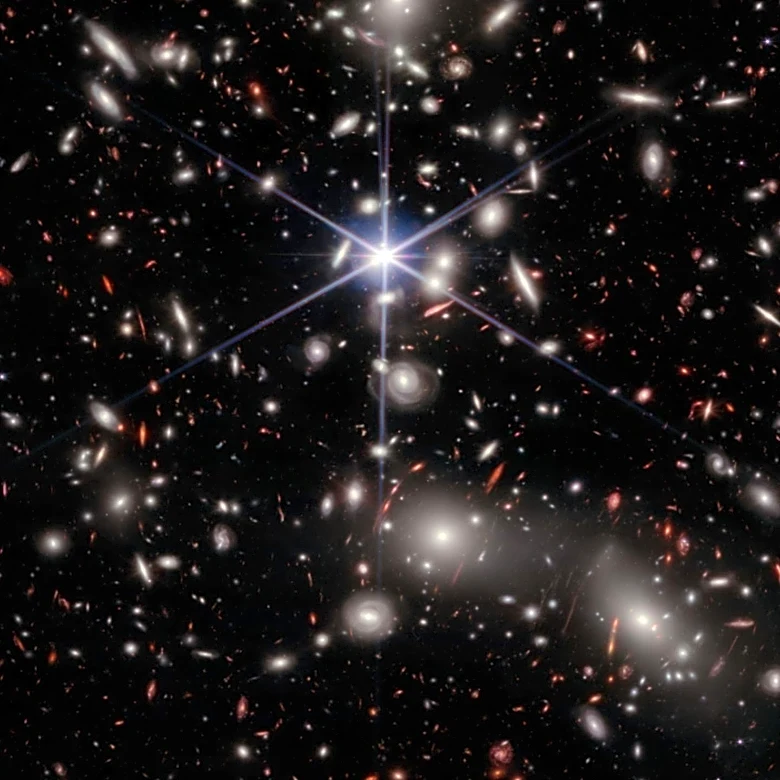
Future observations using advanced telescopes like the James Webb Space Telescope (JWST) and the Hubble Space Telescope (HST) could confirm the presence of the companion object and provide more detailed information about its characteristics. These observations may also help determine the exact orbital period of the companion and its impact on the star's dimming patterns. Continued monitoring of Tabby's Star could lead to new discoveries about the interactions between stars and their surrounding environments. The study's findings may inspire further research into similar stellar phenomena, potentially uncovering new insights into the complexities of the cosmos.