



What's Happening?
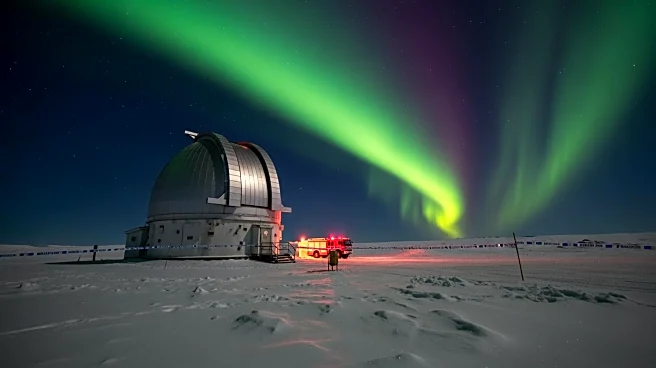
NASA has launched a second sounding rocket from the Poker Flat Research Range in Alaska to study a phenomenon known as black aurora. This mission, part of the Black and Diffuse Aurora Science Surveyor project, is led by Marilia Samara from the Goddard
Space Flight Center. Black auroras occur when streams of auroral particles thin or shut off, creating dark shapes within the broader glow of a diffuse aurora. The mission aims to gather data on these occurrences to better understand the dynamics of auroral activity.
Why It's Important?
The study of black auroras is significant for understanding the complex interactions in Earth's upper atmosphere. These insights can improve our knowledge of space weather, which affects satellite operations, communication systems, and power grids. By understanding the conditions that lead to black auroras, scientists can better predict and mitigate the impacts of space weather on technological infrastructure. This research also contributes to the broader field of atmospheric science, enhancing our understanding of natural phenomena.
What's Next?
The launch window for a third mission, involving two rockets, is set to close on February 20. This upcoming experiment, led by Dartmouth College's Kristina Lynch, will focus on how disturbances in Earth's ionosphere affect auroral curtains. Continued research and data collection from these missions will provide valuable information for future studies and technological applications. The findings may also inform the development of new models to predict space weather events.