





What's Happening?
Paleontologists have re-evaluated the diet of Infernogallus jamesi, commonly known as the 'hell chicken,' a dinosaur from the Cretaceous era. Contrary to its intimidating name, new research suggests this turkey-sized, beaked species primarily consumed
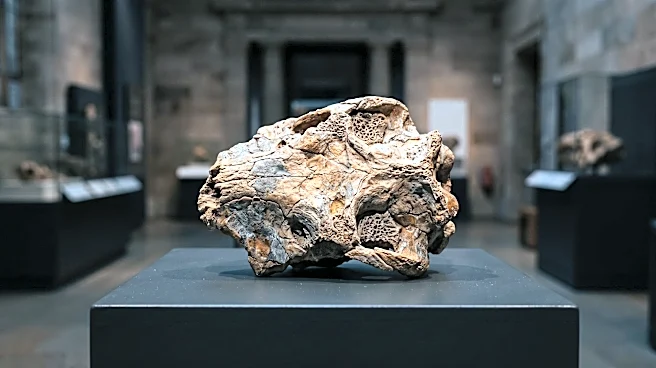
soft fruits rather than meat. This conclusion stems from an extensive review of well-preserved fossilized remains. The study, published in Nature Communications, indicates that I. jamesi and its evolutionary relatives played a role in the development of today's fruit-eating birds. Discovered in 2011 in Montana's Hell Creek Formation, the dinosaur, a caenagnathid, lived approximately 72–66 million years ago alongside species like triceratops and Tyrannosaurus rex. Researchers reconstructed its skull and jaw structure using CT scans, comparing it to modern bird anatomies to understand its feeding mechanisms. The findings reveal that its jaw was designed for a back-and-forth motion, similar to a mortar and pestle, to smash soft foods, rather than a strong up-and-down bite for tearing meat. The absence of gastroliths, or stomach stones, further supports the theory of a fruit-based diet.
Why It's Important?
This reclassification of the 'hell chicken's' diet significantly alters our understanding of Cretaceous-era ecosystems and the evolutionary paths of dinosaurs and birds. It highlights the dietary diversity among dinosaurs and suggests that not all species with formidable appearances were carnivores. The study's implications extend to the co-evolution of plants and dinosaurs, as the caenagnathid evolution likely coincided with a period of shifting climate that saw the proliferation of flowering plants producing larger, nutrient-rich fruits. This research provides valuable insights into how ancient species adapted to their environments and the available food sources, potentially influencing plant dispersal through seed scattering. Understanding these ancient ecological relationships can inform modern ecological studies and conservation efforts by illustrating the complex interdependencies within ecosystems over geological timescales. The findings also underscore the importance of detailed paleontological analysis in refining our knowledge of prehistoric life.
What's Next?
Future research will likely focus on further investigating the precise role of caenagnathids like Infernogallus jamesi in the Late Cretaceous proliferation of fruit and its subsequent impact on early Cenozoic flora. While the current study suggests a correlation between the diversification of Cretaceous plants and oviraptorosaurs (the broader dinosaur group including caenagnathidae), direct evidence to confirm a causal link, such as seed dispersal by these dinosaurs, is still lacking. Paleontologists may seek more fossil evidence, including gut contents or fossilized plant remains in proximity to dinosaur fossils, to solidify these theories. Additionally, comparative studies with other caenagnathid species could provide a broader understanding of dietary adaptations within this group. The ongoing analysis of fossil records and the application of advanced imaging techniques will continue to refine our understanding of dinosaur diets and their ecological roles, potentially leading to further revisions of prehistoric life narratives.
Beyond the Headlines
The re-evaluation of the 'hell chicken's' diet challenges preconceived notions based on superficial characteristics, such as a species' name or physical appearance. This serves as a broader reminder in scientific inquiry to rely on empirical evidence rather than assumptions. Ethically, it highlights the responsibility of scientists to continuously re-examine and update scientific understanding as new data emerges, even if it means overturning long-held beliefs. Culturally, the 'hell chicken' narrative shift from a fearsome predator to a fruit-eater could influence public perception of dinosaurs, moving beyond the dominant image of apex predators to include a wider range of ecological roles. This development also underscores the dynamic nature of scientific knowledge, where conclusions are always subject to revision with new discoveries and analytical methods. The study contributes to a more nuanced and accurate portrayal of prehistoric life, emphasizing the intricate web of life that existed millions of years ago.