




What's Happening?
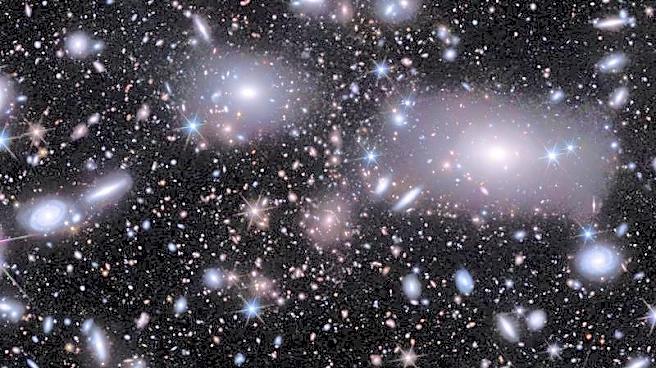
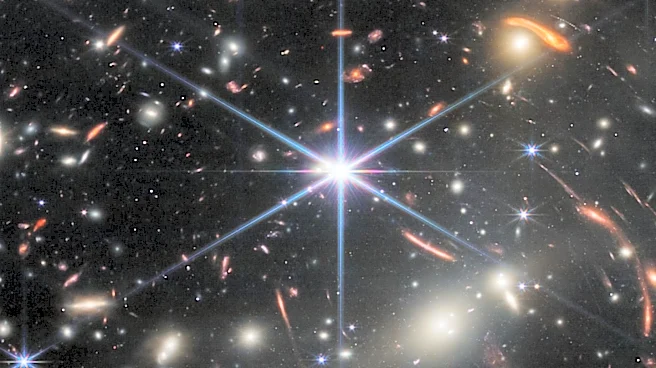
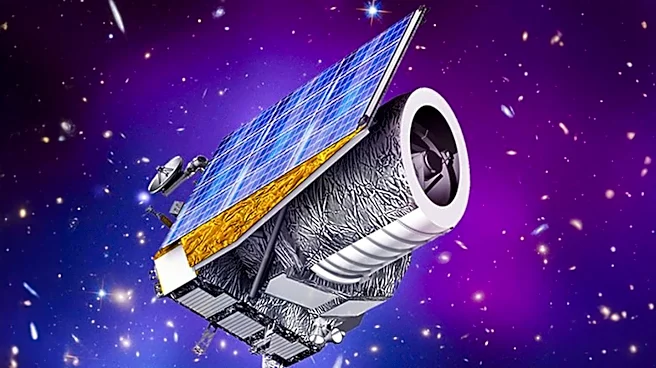
The European Space Agency’s Euclid space telescope has discovered 31 quasars from the early universe, with two of them setting new records as the oldest known. These quasars were observed to be shining with a brightness equivalent to a trillion Suns when
the universe was approximately 670 million years old, which is about 5% of its current age. The oldest newly discovered quasar, EUCL J172902.75+641018.1, has a redshift of 7.77, while EUCL J125308.55+705432.3 has a redshift of 7.69. Both are located just over 13 billion light-years from Earth. These discoveries were made using data from the Euclid Wide Survey, which is designed to cover more than one-third of the sky.
Why It's Important?
This significant discovery provides crucial insights into the formation and evolution of supermassive black holes and galaxies in the very early stages of the universe. Quasars, as extremely bright galactic nuclei powered by supermassive black holes, serve as beacons from the cosmic dawn. The ability of Euclid to identify not only the brightest but also fainter quasars offers a more comprehensive understanding of the early quasar population. This challenges existing models that struggle to explain how such massive black holes could have formed so quickly after the Big Bang. The data from these ancient objects will help astronomers refine theories about the universe's initial conditions and the processes that led to the emergence of large-scale cosmic structures.
What's Next?
The ongoing Euclid Wide Survey is expected to continue uncovering more early universe quasars, further expanding the dataset available for study. Detailed investigations, such as the one already conducted on EUCL J125308.55+705432.3, which revealed its location in a galaxy with intense star formation, will provide more specific information about the environments surrounding these ancient black holes. These observations are vital for understanding the co-evolution of massive galaxies and their central supermassive black holes. The continuous flow of data from Euclid will enable astronomers to develop more accurate models of cosmic evolution and address fundamental questions about the universe's infancy.
Beyond the Headlines
The identification of these record-breaking quasars underscores the transformative power of advanced space telescopes like Euclid. By pushing the boundaries of observational astronomy, scientists are gaining unprecedented access to the universe's distant past, allowing them to witness cosmic events that occurred billions of years ago. This not only deepens our scientific understanding but also inspires a broader appreciation for the vastness and complexity of the cosmos. The continuous refinement of our cosmic narrative, driven by such discoveries, highlights humanity's persistent quest to comprehend its place within the universe and the fundamental laws that govern its existence.