





What's Happening?
The Export-Import Bank of China (CEXIM) has provided a term loan of RM37.40 billion to the Malaysian government for the East Coast Rail Link (ECRL) project. This financing is part of a larger RM52.43 billion project, with the remaining funds sourced through
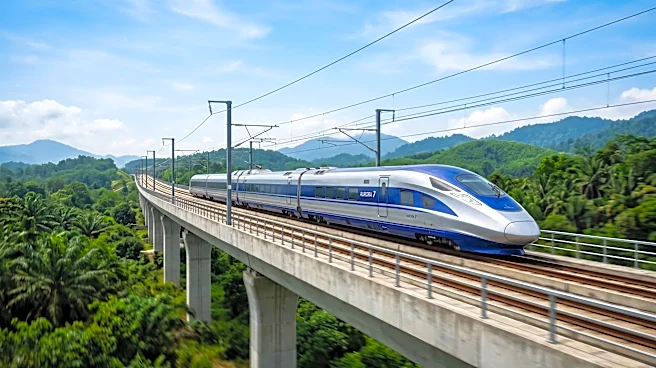
sukuk issuances by local banking institutions. Malaysia Rail Link (MRL) recently secured approval for its fifth sukuk program, valued at RM19.05 billion, to further support the ECRL. This sukuk program is designated as a United Nations Sustainable Development Goals (SDG) sukuk, aligning with sustainable development objectives. As of October 2026, the ECRL project's Kota Bharu-to-Gombak alignment has reached 98.5% completion and is preparing for commercial operations to commence on December 12, 2026.
Why It's Important?
This significant financial involvement by the Export-Import Bank of China in a major infrastructure project like the ECRL highlights China's continued strategic economic engagement in Southeast Asia. For the U.S., this represents a facet of the broader geopolitical competition for influence in the Indo-Pacific region. China's provision of substantial loans for infrastructure development can strengthen its economic ties and potentially increase its leverage with recipient nations. While the project is in Malaysia, the U.S. monitors such developments as they can impact regional trade routes, supply chains, and the overall balance of power. The use of SDG sukuk also indicates a growing trend towards integrating sustainable finance into large-scale infrastructure, which could influence future international financing standards and expectations for similar projects globally.
What's Next?
With the ECRL project nearing completion and commercial operations slated for December 12, 2026, the focus will shift to its operational efficiency and economic impact on Malaysia. The successful implementation of such a large-scale project, heavily financed by China, could serve as a model or precedent for future Chinese-backed infrastructure initiatives in other developing nations. For the U.S., continued observation of these projects will be crucial to understand the evolving economic landscape in Asia and to assess potential implications for U.S. trade and strategic interests in the region. The performance of the SDG sukuk will also be watched as a benchmark for sustainable financing in infrastructure.
Beyond the Headlines
The extensive financing provided by the Export-Import Bank of China for the ECRL project underscores the growing influence of Chinese state-backed financial institutions in global infrastructure development. This trend raises broader questions about debt sustainability in recipient countries and the geopolitical implications of such financial dependencies. While presented as economic cooperation, these large loans can create long-term strategic advantages for China. For the U.S., understanding and potentially countering this financial diplomacy requires a nuanced approach that considers both economic and strategic dimensions. The integration of SDG principles into the sukuk financing also points to an evolving landscape where environmental and social governance factors are increasingly being woven into major financial deals, potentially setting new standards for international development finance.