






What's Happening?
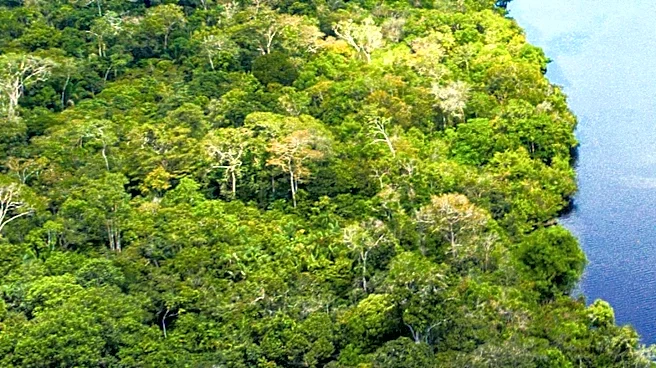
A new World Bank report, 'Advancing Amazonian Conservation through Digital Technologies,' emphasizes the critical role of digital innovation in safeguarding the Amazon rainforest. The report identifies that the Amazon, the world's largest tropical forest,
is facing increasing threats from environmental changes, deforestation, and socio-economic pressures, pushing it towards a tipping point. Digital tools, such as satellite imagery and camera traps, have been instrumental in monitoring deforestation, wildlife, and environmental changes for decades. However, their wider adoption is hindered by high costs, limited technical expertise, and socio-cultural challenges, including complex interfaces and a lack of legal recognition for community-collected data. The report stresses that the full potential of these technologies can only be realized with robust internet connectivity, local capacity building, and strong data governance. Currently, only 3.5% of the Amazon Biome has fixed or mobile broadband coverage, with an even lower rate of 0.69% in Indigenous Territories, due to inconsistent infrastructure, high costs, and geographical barriers.
Why It's Important?
The Amazon rainforest is vital for global environmental stability, regulating rainfall, storing vast amounts of carbon, and supporting immense biodiversity. Its degradation has far-reaching consequences, impacting global climate patterns and accelerating biodiversity loss. The report's findings are crucial because they highlight a strategic pathway to enhance conservation efforts through technology, which could mitigate these global environmental risks. By addressing barriers to digital tool adoption, such as reducing import duties on conservation technologies and investing in local manufacturing, the U.S. and international community can support more effective monitoring and protection of this critical ecosystem. Furthermore, improving internet connectivity and data governance in the Amazon can empower Indigenous Peoples and Local Communities, who are key stewards of the land, to participate more effectively in conservation, thereby fostering sustainable development and protecting human rights.
What's Next?
The World Bank report provides actionable recommendations for the future. Policy priorities include reducing import duties on critical conservation tools to lower costs and increase deployment. There is also a call to invest in local manufacturing and maintenance capabilities, involve Indigenous Peoples and Local Communities in co-designing applications, and build capacity through targeted training to ensure technologies are accessible and culturally appropriate. The report suggests that with these foundations, advanced tools like AI-powered analytics and environmental DNA (eDNA) can be integrated for near real-time tracking of deforestation, biodiversity loss, wildfires, and climate impacts. Solutions for closing the connectivity gap include expanding fiber optic corridors and deploying satellite broadband, alongside promoting community networks and digital skills training. For data governance, the report recommends developing regional frameworks, ensuring interoperability and open data standards, and embedding Indigenous rights and consent in all data policies. Regional institutions like the Amazon Cooperation Treaty Organization (ACTO) are encouraged to act as data custodians, supporting unified repositories for climate-related information.
Beyond the Headlines
The report's emphasis on digital innovation in the Amazon extends beyond mere technological deployment; it delves into the ethical and cultural dimensions of conservation. The call for involving Indigenous Peoples and Local Communities in co-designing tools and ensuring their data sovereignty highlights a shift towards more inclusive and equitable conservation practices. This approach recognizes that effective environmental protection must integrate traditional knowledge with modern technology, respecting the rights and roles of those who have lived in harmony with the forest for generations. The challenges of high costs and limited technical expertise also underscore broader issues of global equity in access to technology and resources for environmental protection. Overcoming these barriers could set a precedent for how technology is deployed in other vulnerable ecosystems worldwide, fostering a model of conservation that is both technologically advanced and socially just.