







What's Happening?
Emmylou Vaxby, a 14-year-old mudlark and author, has spent nearly a decade searching the Thames foreshore in London for historical artifacts. Accompanied by a reporter, Vaxby demonstrated her method of identifying treasures among the silt and rocks exposed
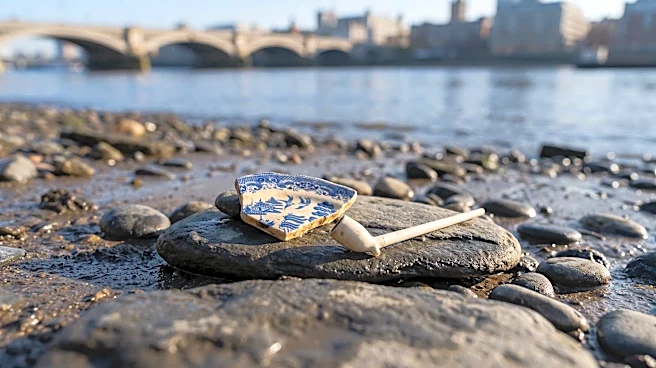
by low tide, looking for objects of different colors. During their search, they found a mud-brown bone, which Vaxby explained could have belonged to various animals and might have been discarded by a butcher or simply thrown into the river. She noted the difficulty in determining its exact age but confirmed it had been there for many years, drawing a parallel to the 'Great Stink' of 1858 when the Thames was heavily polluted. Vaxby's hobby, which began around age five or six, intensified during lockdown, leading her to document her findings and research on a blog and YouTube channel under the name 'Emmylou the Mudlark.' Her discoveries include cobalt-glazed chinoiserie pottery, clay tobacco pipes dating from the 16th to 19th centuries, and various shells.
Why It's Important?
Emmylou Vaxby's mudlarking activities highlight the significant historical and archaeological value embedded within urban riverbeds, offering a unique perspective on the past. Her dedication to this unusual hobby, which requires a permit from the Port of London Authority, demonstrates how individual efforts can contribute to the preservation and understanding of local history. By uncovering everyday objects, Vaxby provides tangible links to the lives of previous generations, from Georgian and Victorian eras to earlier centuries. Her work also underscores the importance of citizen science and public engagement in historical research, as mudlarkers are required to record and report their finds through the Portable Antiquities Scheme. Furthermore, Vaxby's initiative in founding the Wapping Plastic-Free Community and organizing riverbank clean-ups connects historical preservation with contemporary environmental concerns, showing how an appreciation for the past can inspire action for a sustainable future. Her story also serves as an inspiration for young people to pursue unique interests and develop expertise outside traditional academic settings.
What's Next?
Emmylou Vaxby's continued mudlarking efforts are expected to yield further historical discoveries along the Thames. Having already authored a book, 'A Guide to Mudlarking on the River Thames,' she will likely continue to share her findings and research through her blog and YouTube channel, 'Emmylou the Mudlark.' Her work with the Wapping Plastic-Free Community, including organizing twice-yearly riverbank clean-ups and participating in other litter picks, will persist, contributing to environmental conservation alongside historical exploration. As a recognized mudlark, she will continue to adhere to the requirement of recording and reporting her finds through the Portable Antiquities Scheme, ensuring that any significant artifacts are properly documented and preserved. Her growing expertise and public profile may also lead to further opportunities for educational outreach, inspiring others to engage with local history and environmental stewardship.
Beyond the Headlines
Emmylou Vaxby's story transcends a simple hobby, touching upon deeper themes of historical connection, environmental responsibility, and personal fulfillment. Her meditative approach to mudlarking, described as her 'happy place,' offers a counter-narrative to the fast-paced digital world, emphasizing the value of slow, observational engagement with the physical environment. The contrast she draws between her recreational mudlarking and the necessity for Victorian children to do the same for a livelihood highlights significant socio-economic shifts and the privilege of pursuing such interests today. Ethically, her commitment to reporting finds through the Portable Antiquities Scheme underscores the importance of responsible artifact recovery and the ethical considerations inherent in interacting with historical sites. Culturally, her work contributes to a broader understanding of London's past, not through grand narratives, but through the intimate details of everyday objects, fostering a more tangible and relatable connection to history for the public.