

What's Happening?
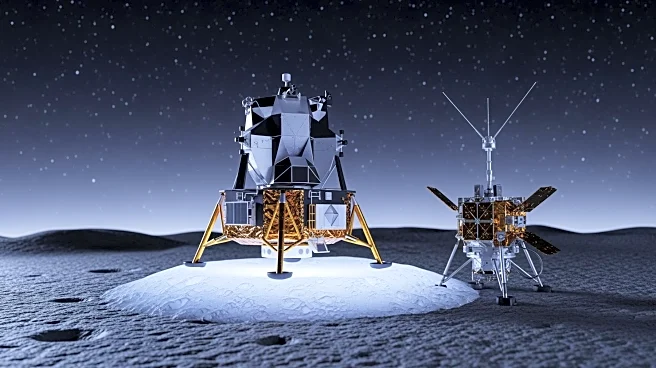
NASA is advancing its Artemis program by selecting new scientific payloads to study the Moon's terrain, radiation, and history. These payloads are part of the Commercial Lunar Payload Services (CLPS) initiative, which aims to leverage U.S. industry innovation
for lunar exploration. The selected payloads include the Emission Imager for Lunar Infrared Analysis in 3D (EMILIA-3D), Lunar Instrumentation for Subsurface Thermal Exploration with Rapidity (LISTER), and Site-agnostic Energetic Lunar Ion and Neutron Environment (SELINE). These instruments will help create thermal models of the lunar surface, measure the Moon's interior heat flow, and study its radiation environment. The payloads are expected to be delivered to the lunar surface no earlier than 2028.
Why It's Important?
The deployment of these payloads is crucial for advancing scientific understanding of the Moon, which is a key objective of NASA's Artemis program. By studying the lunar terrain and radiation, NASA aims to gather data that will inform future human exploration and potential lunar habitation. The initiative also supports the growth of a lunar economy by involving commercial partners in space exploration. This collaboration could lead to technological advancements and economic opportunities in the space industry, positioning the U.S. as a leader in lunar exploration.
What's Next?
NASA plans to assign the selected payloads to specific CLPS delivery task orders at a later date. As the Artemis program progresses, further collaborations with commercial partners are expected to enhance the capabilities for lunar exploration. The data collected from these missions will be critical for planning future manned missions to the Moon and potentially establishing a sustainable human presence on the lunar surface.