



What's Happening?
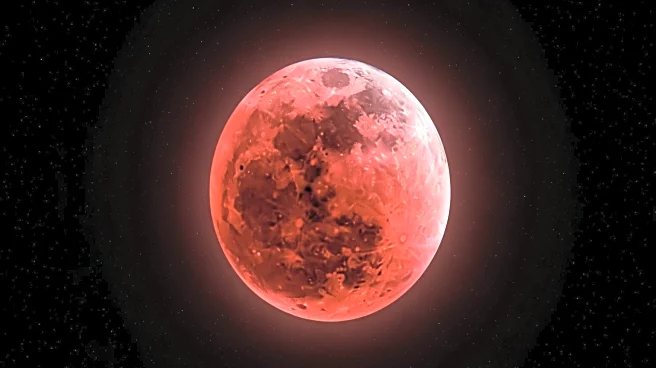
Michigan residents will have the opportunity to witness a 'blood moon' during a total lunar eclipse on March 3, 2026. The eclipse will coincide with the worm moon, a full moon that will peak at 6:38 a.m. The total lunar eclipse will be visible from western
North America, Australia, New Zealand, and East Asia, with the blood moon phase lasting for 58 minutes. Although the moon will set during totality in the Eastern time zone, Michigan viewers can still expect to see the moon take on a dramatic red or orange hue. This phenomenon occurs as sunlight passes through Earth's atmosphere, scattering shorter wavelengths and allowing longer wavelengths like red and orange to reach the moon's surface.
Why It's Important?
The upcoming lunar eclipse offers a rare celestial event for Michigan residents and others in the viewing regions. Such events provide opportunities for educational engagement and public interest in astronomy. The visibility of the blood moon can inspire interest in space science and encourage community gatherings for viewing. Additionally, the event highlights the importance of preserving dark sky areas, which are crucial for observing astronomical phenomena without light pollution. This eclipse also serves as a reminder of the interconnectedness of global natural events, as it will be visible across multiple continents.
What's Next?
Following the March lunar eclipse, Michigan will experience a partial lunar eclipse on August 28, 2026. This will be another opportunity for residents to engage with astronomical events. The state is home to several dark sky parks, which will provide ideal viewing locations for these events. As interest in astronomy grows, there may be increased advocacy for the preservation of dark sky areas and educational programs to enhance public understanding of celestial phenomena.