






What's Happening?
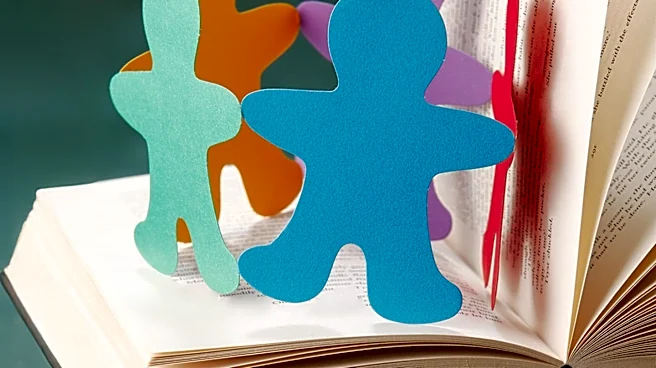
New primary school textbooks in Greece, slated for use starting in the 2027–2028 school year, will include depictions of families with same-sex parents. The 2nd-grade Language textbook, 'My Language,' features illustrations of families with two fathers
or two mothers, asking students to identify and draw their own family. The 6th-grade Social and Political Education textbook, authored by sociologist Manousos Maragkoudakis, systematically classifies various family forms, including a specific reference to 'a family with two parents of the same sex.' This development is part of a broader 'Multiple Textbook' reform, where teachers will have several approved options for teaching materials. Government spokesman Pavlos Marinakis has stated there is 'no woke agenda' in the government, emphasizing traditional definitions of father and mother, while the Ministry of Education asserts the textbooks underwent evaluation by independent scientific committees. The author of the 6th-grade textbook, Maragkoudakis, argues that the inclusion reflects contemporary social and legal realities, not ideological promotion. This initiative comes as Greece has legally recognized civil marriage between same-sex individuals through Law 5089/2024, which also introduced provisions for parental responsibility and family rights.
Why It's Important?
The introduction of diverse family structures in Greek school textbooks reflects a significant societal shift and has implications for educational policy and social acceptance. This move acknowledges the evolving reality of family life in Greece, where, according to the Hellenic Statistical Authority (ELSTAT), the number of civil partnerships and divorced individuals has significantly increased between 2011 and 2021, while the number of married people has decreased. By presenting various family models, including same-sex parents, the textbooks aim to mirror a more inclusive society. This is particularly important for children from non-traditional families, as it can foster a sense of belonging and validation. However, the debate surrounding these textbooks highlights a tension between traditional values and modern social realities. The government's stance, as articulated by spokesman Pavlos Marinakis, underscores the ongoing cultural and political discussions about family definitions and the role of education in shaping societal norms. The pedagogical question of how and at what age to introduce these concepts remains central to the controversy, impacting how future generations perceive and understand family units.
What's Next?
The new textbooks are scheduled for full implementation in the 2027–2028 school year, under the 'Multiple Textbook' system. This system allows teachers to choose from several approved textbooks for each subject, meaning the final educational material used in classrooms will depend on individual teacher selections. The Ministry of Education has already approved 230 textbooks/teaching packages, and teachers have begun selecting their preferred materials. The ongoing public debate is expected to continue as the implementation date approaches, with discussions focusing on the pedagogical appropriateness of presenting diverse family structures to children of different ages. Stakeholders, including parents, educators, and political figures, will likely continue to voice their opinions on the content and its alignment with educational goals and societal values. The long-term impact will be observed in how these changes influence children's understanding of family and how the educational system adapts to reflect contemporary social realities while navigating traditional expectations.
Beyond the Headlines
The controversy surrounding the new Greek school textbooks extends beyond mere curriculum changes, touching upon deeper ethical, legal, and cultural dimensions. Ethically, the debate centers on whether educational materials should reflect existing societal diversity or uphold traditional norms. The legal recognition of same-sex civil marriage in Greece provides a legal basis for including same-sex parent families, suggesting that the textbooks are aligning with the country's legal framework. Culturally, this development signifies a broader shift in how Greek society views and defines family, moving away from a singular, traditional model towards a more pluralistic understanding. The 'Multiple Textbook' system itself represents a significant pedagogical shift, empowering teachers with more autonomy in selecting materials, which could lead to varied classroom experiences across the country. This situation highlights the ongoing global tension between progressive social changes and conservative reactions, particularly in the context of education, where the values instilled in children are often seen as foundational to national identity and social cohesion. The outcome in Greece could serve as a case study for other nations grappling with similar issues.