
What's Happening?
An engineer named Tim has successfully developed an image generation diffusion model capable of running on an RP2350 microcontroller. This project addresses a growing interest in running AI models on local
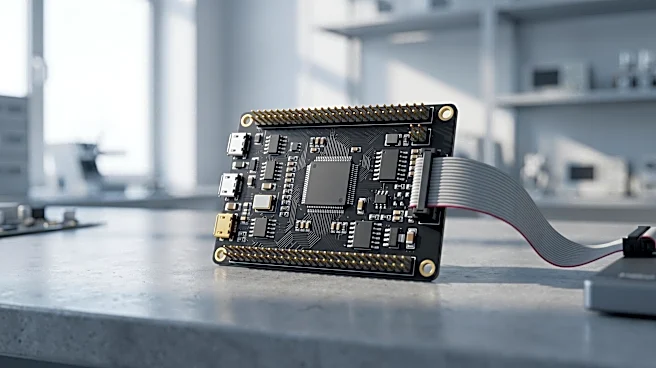
hardware, driven by desires for increased privacy, customization, and reduced costs. The model, while limited in its capabilities, is notable for its ability to operate on such constrained hardware. It generates 128x128 resolution images of human faces, with each image taking approximately twenty seconds to produce. The system runs on a Waveshare RP2350 development board and can output generated images via USB or display them using a VGA adapter board. The generative process involves a latent flow diffusion transformer that iteratively refines noise into a desired image, guided by an output class for specific features like a smiling face. Tim trained two models, optimizing them for size and speed, and quantized their weights to 8-bit integers, allowing both models and the inference program to fit within 4 MB of flash memory.
Why It's Important?
This development is significant as it pushes the boundaries of what is possible with generative AI on low-power, embedded systems. It demonstrates that sophisticated AI capabilities, traditionally requiring powerful cloud infrastructure or high-end GPUs, can be adapted for more accessible and resource-constrained hardware. This has implications for various applications where on-device AI processing is beneficial, such as enhanced privacy (data never leaves the device), reduced latency, and operation in environments without reliable internet connectivity. The ability to run generative models locally could democratize access to AI tools, fostering innovation in areas like personalized content creation, embedded vision systems, and edge computing. It also highlights the ongoing trend of optimizing AI models for efficiency, making them more practical for widespread deployment in diverse hardware environments.
What's Next?
The success of running a generative AI model on an RP2350 microcontroller suggests a future where more complex AI tasks could be performed on edge devices. Further research and development will likely focus on improving the resolution, speed, and diversity of images generated on such hardware. Optimizations in model architecture, quantization techniques, and specialized hardware accelerators for microcontrollers could lead to even more capable on-device AI. This could pave the way for new applications in consumer electronics, industrial IoT, and smart home devices, where real-time, private, and efficient AI processing is crucial. The project also encourages broader exploration into how AI can be made more accessible and less reliant on centralized, high-computation resources, potentially leading to a more distributed and resilient AI ecosystem.
Beyond the Headlines
This project touches upon deeper implications regarding the decentralization of artificial intelligence. By enabling generative AI on microcontrollers, it challenges the prevailing paradigm of AI being primarily cloud-dependent. This shift could empower individuals and small developers to create AI-powered applications without significant infrastructure costs or reliance on large tech companies. Ethically, local AI processing enhances user privacy by keeping data on the device, reducing concerns about data breaches and surveillance. Environmentally, running AI on low-power devices could contribute to more sustainable computing by reducing the energy consumption associated with large data centers. Culturally, it could foster a new wave of creative applications, allowing users to generate personalized content directly from their devices, leading to more interactive and customized digital experiences. This development represents a step towards a more ubiquitous, private, and energy-efficient future for artificial intelligence.