




What's Happening?
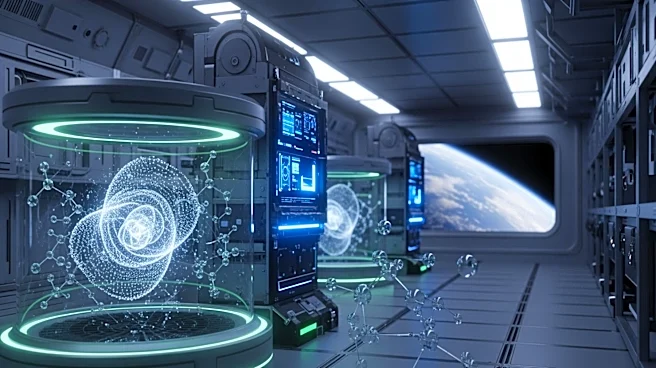
NASA's Expedition 74 crew aboard the International Space Station is focusing on significant scientific projects involving quantum physics, biomedicine, and computer networking. NASA flight engineer Jessica Meir is working on advanced space physics investigations,
including connecting fiber optic cables in the Cold Atom Lab for quantum research. This research aims to explore atomic wave functions and general relativity. Additionally, ESA's Sophie Adenot is conducting biomedical research to create intravenous fluid from spacecraft drinking water, promoting self-sufficiency in space. The crew is also updating computer hardware to enhance real-time data monitoring and communication. These activities are part of ongoing efforts to support long-term space missions and improve life on Earth through advanced manufacturing techniques.
Why It's Important?
The research conducted on the International Space Station has far-reaching implications for both space exploration and terrestrial applications. Quantum physics experiments could lead to breakthroughs in understanding fundamental forces and particles, potentially impacting fields like computing and materials science. The biomedicine research aims to reduce dependency on Earth-based supplies, crucial for future deep-space missions. This self-sufficiency is vital for long-duration missions to the Moon and Mars, where resupply opportunities are limited. The technological advancements in data monitoring and communication also enhance the efficiency and safety of space missions, contributing to the overall success of NASA's exploration goals.
What's Next?
As NASA continues to push the boundaries of space research, the findings from these experiments will likely inform future missions and technological developments. The success of these projects could lead to more sophisticated space missions with enhanced capabilities for scientific discovery. Additionally, the knowledge gained from these experiments may translate into new technologies and products on Earth, benefiting industries such as healthcare, manufacturing, and computing. NASA's ongoing commitment to international collaboration and innovation will play a crucial role in shaping the future of space exploration.