
What's Happening?
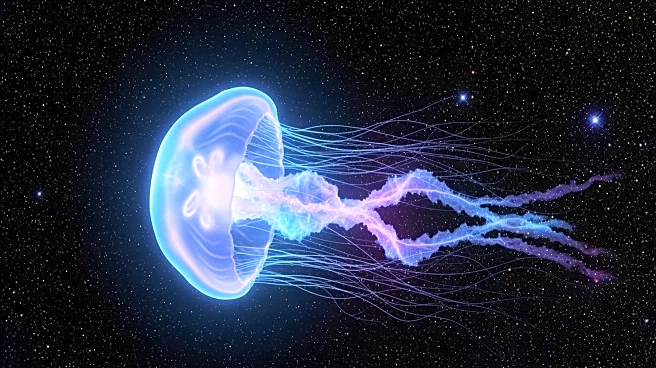
The James Webb Space Telescope (JWST) has identified a distant jellyfish galaxy, named COSMOS2020-635829, located 8.5 billion light-years away. This discovery was made during deep observations of the Cosmic Evolution Survey Deep field. Jellyfish galaxies
are characterized by their long trails of gas, formed through a process known as ram-stripping, where strong winds in galaxy clusters push gas out of the galaxies' disks. The galaxy appears as it existed roughly 5.3 billion years after the Big Bang, a period when galaxy clusters were still forming. The JWST image shows the galactic disk with distinct gaseous tails, within which bright blue knots of young stars are visible. These stars were born outside the galaxy's main disk, forming directly within the ram-stripped gas.
Why It's Important?
This discovery is significant as it challenges previous assumptions about the conditions in galaxy clusters 8.5 billion years ago. Researchers had believed that such clusters would not generate enough pressure to trigger widespread ram-stripping. The observation suggests that cluster environments were already harsh enough to strip galaxies and alter their properties earlier than expected. This insight could help explain the formation of 'dead' galaxies observed in clusters today. The findings provide rare insight into how galaxies were transformed in the early universe, potentially reshaping our understanding of galactic evolution during the universe's adolescence.
What's Next?
The research team plans to continue studying COSMOS2020-635829 with the James Webb Space Telescope to further explore the mysteries surrounding jellyfish galaxies and the forces that shaped them billions of years ago. This ongoing research could provide more detailed insights into the processes that influence galaxy formation and evolution in the early universe.