



What's Happening?
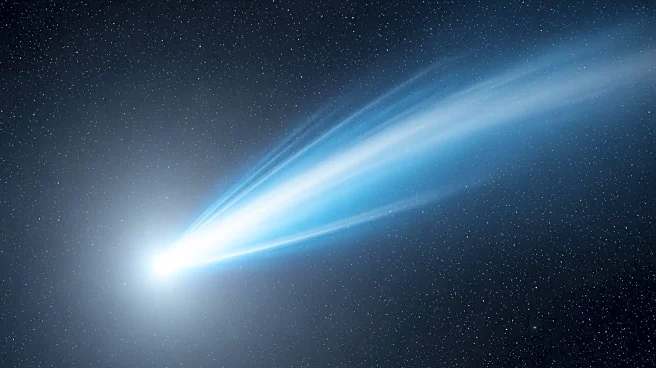
Comet 3I/ATLAS, an interstellar object, is accelerating as it approaches its closest point to Earth. Scientists have observed significant non-gravitational accelerations in the comet, attributed to the release of gas as it nears the Sun. Despite its acceleration,
NASA confirms that the comet poses no threat to Earth, as it will pass no closer than 170 million miles. The comet, first discovered in July by NASA's ATLAS survey telescope, is on a hyperbolic trajectory, indicating it is not bound by the Sun's gravity and is merely passing through the solar system.
Why It's Important?
The observation of Comet 3I/ATLAS provides valuable insights into the behavior of interstellar objects and their interactions with the solar system. Understanding these dynamics can enhance scientific knowledge of cometary physics and the processes governing non-gravitational accelerations. The comet's passage also offers an opportunity for astronomers to study its composition and trajectory, contributing to broader research on the origins and characteristics of interstellar bodies. Public interest in such celestial events can also promote engagement with space science and education.