





What's Happening?
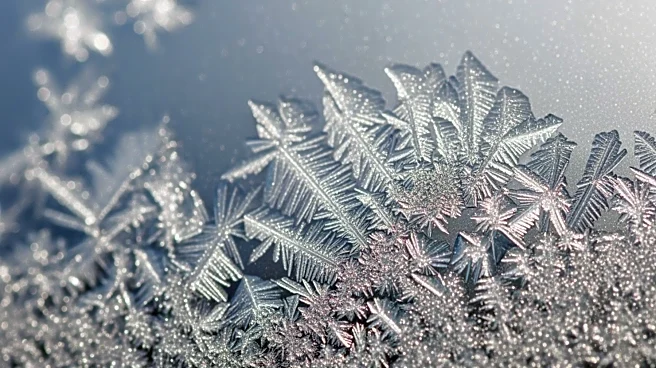
Physicists have discovered three new complex phases of ice, including two of the most intricate forms ever observed. This discovery was made possible through advanced experimental techniques that involve compressing water under extreme conditions. The
research, conducted by scientists at Lawrence Livermore National Laboratory and other institutions, has revealed that water can form a variety of crystalline structures depending on the pressure and temperature applied. These findings challenge previous assumptions about the behavior of water and ice, suggesting that there are many more potential phases than previously thought. The new phases, including one named ice XXI, were identified using high-powered X-ray lasers to analyze the molecular structure of ice under pressure. This research not only expands the understanding of water's versatility but also has implications for other fields, such as pharmaceuticals, where phase transitions can affect drug efficacy.
Why It's Important?
The discovery of new ice phases is significant as it enhances the understanding of water's behavior under different environmental conditions, which is crucial for various scientific fields. In particular, the findings could impact the pharmaceutical industry, where the phase of a drug can influence its effectiveness. Understanding these transitions can help in predicting and preventing unwanted changes in drug formulations. Additionally, the research provides insights into the potential existence of exotic ice forms in extraterrestrial environments, which could inform future space exploration missions. The study also supports Ostwald's step rule, a theory of phase transitions that could apply to other crystalline materials, further broadening its scientific relevance.
What's Next?
Following the discovery, researchers are likely to continue exploring the potential applications of these new ice phases. This could involve further experiments to understand the conditions under which these phases form and their stability. The findings may also prompt additional studies into the implications for other materials and industries, particularly in pharmaceuticals and materials science. As the understanding of phase transitions improves, it could lead to innovations in how materials are manufactured and used, potentially leading to more efficient and effective products.
Beyond the Headlines
The discovery of new ice phases also raises questions about the fundamental principles of phase transitions and the potential for discovering even more complex structures. This could lead to a reevaluation of existing theories and models in physics and chemistry. Additionally, the research highlights the importance of interdisciplinary collaboration, as advancements in technology and experimental techniques have been crucial in making these discoveries possible. The findings may also inspire further exploration of the role of metastable states in other scientific phenomena, potentially leading to breakthroughs in understanding complex systems.