







What's Happening?
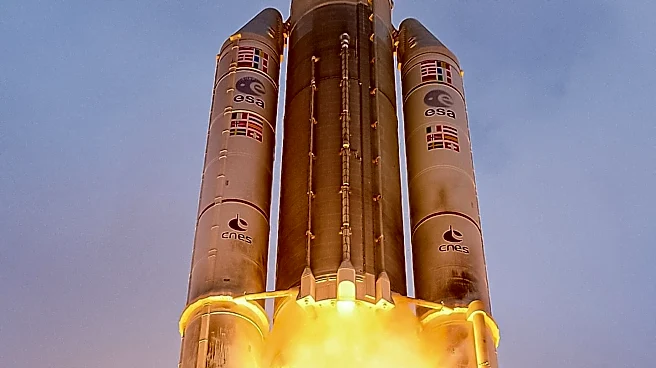
The French government, through the National Centre for Space Studies (CNES), oversees the launch authorizations for the Ariane 6 launcher, a key project aimed at providing European states with independent access to space. This initiative is part of a broader
EU effort to enhance autonomy, competitiveness, and security in the space sector. The Ariane 6 development is supported by the European Space Agency and is integral to the EU's integrated space program. France plays a significant role in this initiative, contributing to the European satellite constellation IRIS² and reducing reliance on non-EU technologies. The French space industry is deeply embedded in EU space policy, participating in major projects like Galileo and Copernicus.
Why It's Important?
The development of the Ariane 6 launcher is crucial for the EU's strategic autonomy in space, reducing dependency on non-European launch services. This independence is vital for the EU's security and competitiveness in the global space industry. The initiative also supports technological innovation within Europe, fostering economic growth and job creation in the space sector. By investing in projects like IRIS², the EU aims to enhance its capabilities in satellite communications and Earth observation, which are essential for various applications, including climate monitoring and defense. The project also strengthens the EU's position in international space governance and policy-making.
What's Next?
The continued development and successful deployment of the Ariane 6 launcher will likely lead to increased collaboration among EU member states in space projects. This could result in more integrated and cohesive space policies across Europe. The EU's commitment to space autonomy may also encourage further investments in space technology and infrastructure, potentially leading to new partnerships with private sector companies. As the EU enhances its space capabilities, it may also play a more prominent role in global space governance, advocating for international regulations and standards that align with its strategic interests.
Beyond the Headlines
The Ariane 6 project highlights the growing importance of space as a domain for geopolitical influence and economic development. As space activities become more commercialized, legal and regulatory frameworks will need to adapt to address issues such as space debris, cybersecurity, and the dual-use nature of space technologies. The EU's focus on space autonomy also reflects broader trends in global politics, where nations seek to secure their technological and strategic interests in an increasingly competitive environment. This development underscores the need for international cooperation and dialogue to ensure the sustainable and peaceful use of outer space.