



What's Happening?
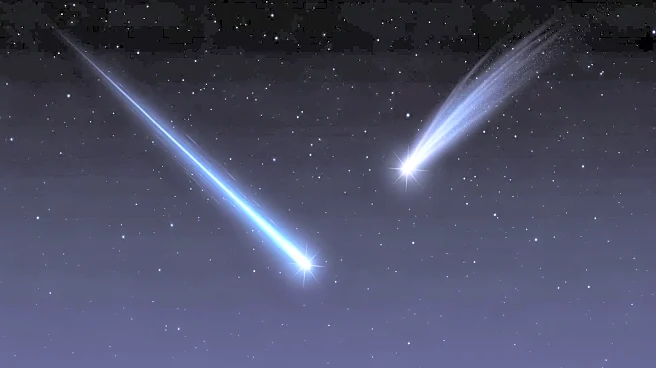
On December 15, 2025, skywatchers are treated to a celestial spectacle featuring the fading Geminid meteor shower and a rare interstellar comet, Comet 3I/ATLAS, which is turning green. The Geminids, although past their peak, continue to provide a visual
treat with 20-30 meteors per hour possible under dark skies. Meanwhile, Comet 3I/ATLAS, the third known interstellar object, is brightening and displaying a green hue due to carbon-bearing molecules. The Orion Nebula also reaches its prime viewing position, offering a rich target for telescope users. The Northern Hemisphere's long winter nights enhance the visibility of these celestial events.
Why It's Important?
This convergence of celestial events underscores the dynamic nature of the night sky and the ongoing interest in astronomical phenomena. The presence of an interstellar comet like 3I/ATLAS highlights the vastness and interconnectedness of our solar system with the broader universe. The Geminid meteor shower, originating from an asteroid, challenges traditional comet-based meteor shower models, prompting further scientific exploration. These events provide educational opportunities and inspire public interest in space science, emphasizing the importance of preserving dark skies for future observations.
What's Next?
As the Geminid meteor shower concludes, attention will shift to the Ursid meteor shower, peaking around December 21-22, 2025. Comet 3I/ATLAS will make its closest approach to Earth on December 19, offering a prime viewing opportunity for those with telescopes. The winter solstice on December 21 marks the longest night of the year in the Northern Hemisphere, providing extended stargazing opportunities. These events continue to engage the public and foster a deeper appreciation for astronomy.