


What's Happening?
U.S. Senator Peter Welch (D-Vermont), alongside Senate Democratic Leader Chuck Schumer (D-N.Y.), U.S. Senators Bernie Sanders (I-Vt.), Kirsten Gillibrand (D-N.Y.), and U.S. Representative Becca Balint (VT-AL), has formally requested the U.S. Fish and Wildlife
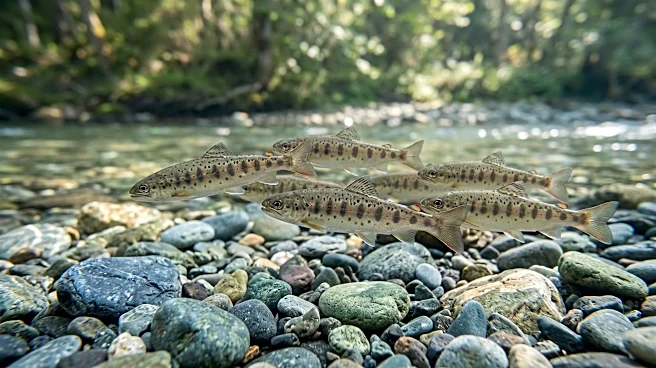
Services (USFWS) to reverse its decision to place Vermont’s White River National Fish Hatchery on inactive status. In a letter addressed to USFWS Director Brian Nesvik, the lawmakers expressed concerns that this action would hinder valuable scientific research and jeopardize a decade of progress in fishery restoration efforts, particularly concerning Atlantic salmon. The hatchery, operational since 1984, has been crucial in restoring native fish species in Lake Champlain, the Connecticut River, and the Great Lakes. The lawmakers highlighted significant achievements, including the discovery of wild-hatched Atlantic salmon fry in the Winooski River in 2016—the first in 150 years—and a substantial reduction in sea lamprey wounding of Atlantic salmon from 79% to 6% by 2022. They are requesting a full evaluation of all regional facilities to understand the potential impact on Lake Champlain and long-standing service priorities before any final determination is made.
Why It's Important?
The potential closure or inactive status of the White River National Fish Hatchery carries significant implications for environmental conservation, the outdoor recreation economy, and federal funding priorities in the U.S. Northeast. The hatchery plays a vital role in the restoration of native fish populations, such as Atlantic salmon and lake trout, which are critical for maintaining ecological balance in major waterways like Lake Champlain. The lawmakers emphasized that successful fishery restoration efforts directly bolster the outdoor recreation economy in Vermont and New York, supporting local businesses and tourism. Furthermore, the bipartisan appeal underscores a broader congressional commitment to the National Fish Hatchery System, which received a nearly $3.5 million increase in funding for FY26, totaling $79 million for operations and an additional $24.5 million for maintenance and equipment. Halting operations at a facility that has demonstrated tangible success in species recovery and invasive species control could undermine public trust in conservation initiatives and set back years of dedicated work and investment.
What's Next?
The lawmakers have requested that USFWS stay the decision to place the White River National Fish Hatchery on inactive status and provide a briefing on their plans for the hatchery by October 30, 2026. This indicates an immediate push for reconsideration and transparency from the USFWS. The agency will likely need to respond to the congressional inquiry, potentially leading to a re-evaluation of the decision or a detailed justification for their proposed action. Stakeholders, including environmental groups, local communities, and the outdoor recreation industry in Vermont and New York, will be closely monitoring the USFWS's response. Depending on the outcome, there could be further legislative action, public advocacy campaigns, or adjustments to federal conservation strategies. The situation highlights an ongoing tension between federal agency operational decisions and congressional oversight regarding environmental and economic impacts.
Beyond the Headlines
The debate over the White River National Fish Hatchery extends beyond immediate operational concerns, touching upon the long-term sustainability of federal conservation programs and the delicate balance between economic development and ecological preservation. The success stories cited by the lawmakers, such as the return of wild-hatched Atlantic salmon and the reduction of sea lamprey impact, demonstrate the tangible benefits of sustained investment in fish hatcheries. An inactive status could signal a shift in federal priorities or resource allocation, potentially impacting other national fish hatcheries and their respective conservation missions. This situation also highlights the interconnectedness of ecosystems across state lines, as the hatchery's work benefits both Vermont and New York. The outcome could influence future policy decisions regarding the funding and management of critical environmental infrastructure, emphasizing the need for robust scientific research and consistent federal support to achieve ambitious conservation goals.