



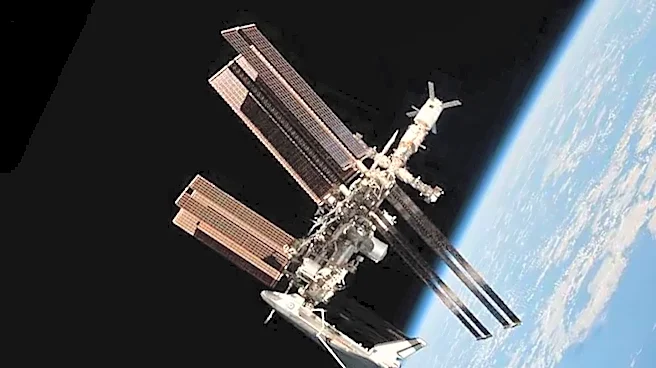

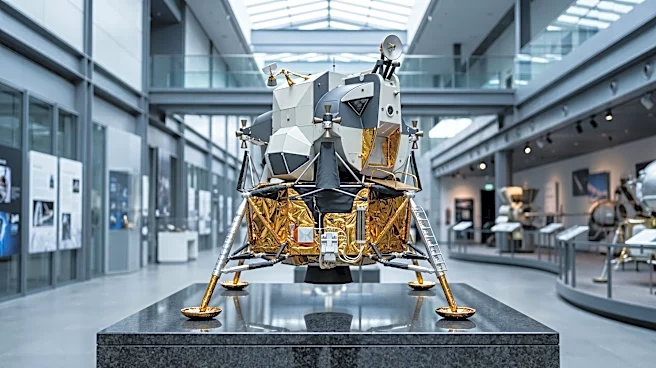

What's Happening?
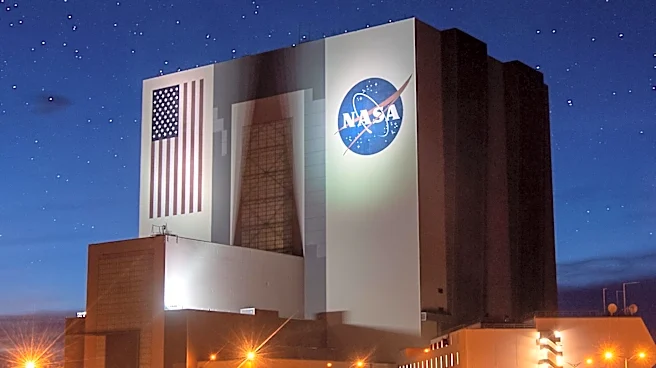
The National Aeronautics and Space Administration (NASA) was established on October 1, 1958, as a new civilian agency, absorbing the existing National Advisory Committee for Aeronautics. This creation followed a period of intense competition in space,
notably after the Soviet Union launched Sputnik in 1957, which spurred significant U.S. investment in science and technology. Prior to NASA's formation, the U.S. launched Explorer 1 in January 1958, discovering the Van Allen radiation belts. The decision to make space exploration a civilian endeavor, rather than military-led like the Soviet program, was a significant policy choice by President Dwight Eisenhower. This approach led to a public-facing program where astronauts became celebrities and failures were often televised, contrasting sharply with the secretive Soviet model.
Why It's Important?
The establishment of NASA as a civilian agency was crucial for shaping the trajectory of U.S. space exploration and its public perception. By operating transparently, NASA fostered public trust and engagement, turning astronauts into national heroes and making space missions a shared national experience. This civilian oversight also allowed for a broader focus on scientific research and technological development beyond purely military objectives. The rapid expansion of NASA's budget in the early 1960s, particularly after President John F. Kennedy's commitment to a Moon landing, spurred immense innovation. This investment not only advanced space technology but also had profound spillover effects on the U.S. economy, particularly in the development of integrated circuits and software engineering, which became foundational for the modern technological landscape.
What's Next?
While the source primarily focuses on historical context, the legacy of NASA's founding continues to influence its current and future endeavors. The agency remains at the forefront of space exploration, with ongoing missions to the Moon (Artemis program), Mars, and beyond, continuing its civilian-led approach to scientific discovery and technological advancement. The principles of public engagement and scientific transparency established at its inception are still central to NASA's operations. Future developments will likely involve further international collaborations, commercial partnerships, and continued efforts to inspire the next generation of scientists and engineers, building on the foundation laid in 1958.
Beyond the Headlines
The creation of NASA represented a pivotal moment in the Cold War, transforming the space race from a purely military competition into a broader contest of scientific and technological prowess, with significant cultural implications. The civilian nature of NASA allowed for a more open scientific exchange and public participation, which arguably contributed to its long-term success and enduring public support. The agency's early challenges, such as the Apollo 1 fire, led to critical safety improvements and a culture of rigorous engineering that became a hallmark of its operations. Furthermore, the technological demands of the space program, particularly the Apollo Guidance Computer, directly accelerated the development of integrated circuits and software engineering, technologies that underpin virtually all modern electronics and computing, demonstrating how ambitious public projects can drive widespread economic and technological transformation.