






What's Happening?
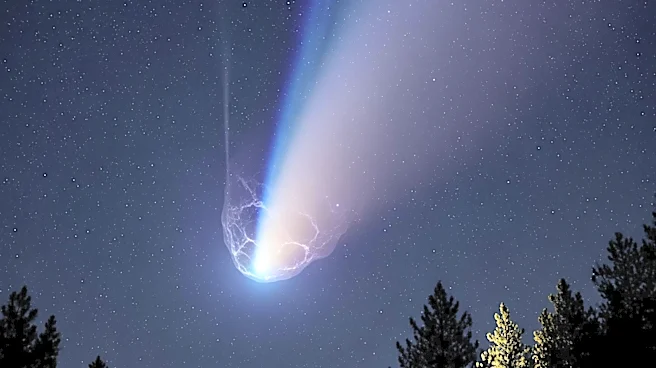
Comet C/2025 R3 (PanSTARRS) has become a notable feature in the early-morning sky, visible near the Great Square of Pegasus. The comet, which was initially observed at 8th magnitude, is expected to brighten further, making it accessible to amateur astronomers.
Rising around 3:40 A.M. local daylight time, the comet can be seen climbing above the horizon, offering a spectacular view for stargazers. As the month progresses, the comet will become less visible in the Northern Hemisphere, transitioning to Southern Hemisphere skies.
Why It's Important?
The appearance of Comet C/2025 R3 (PanSTARRS) provides a unique opportunity for both professional and amateur astronomers to study a celestial object that is not frequently visible. Observing comets can yield valuable information about the composition and behavior of these ancient solar system bodies. The comet's visibility also encourages public interest in astronomy and space science, fostering a greater appreciation for the night sky and the universe. Such events can inspire educational activities and community engagement in astronomical observations.
What's Next?
As Comet C/2025 R3 (PanSTARRS) continues its journey through the solar system, astronomers will monitor its brightness and trajectory. The comet's movement into Southern Hemisphere skies will provide new opportunities for observation and study. Future observations may focus on analyzing the comet's tail and any disconnection events, which can offer insights into the solar wind's effects on cometary bodies. The data collected from this comet will contribute to the broader understanding of cometary dynamics and their role in the solar system.