




What's Happening?
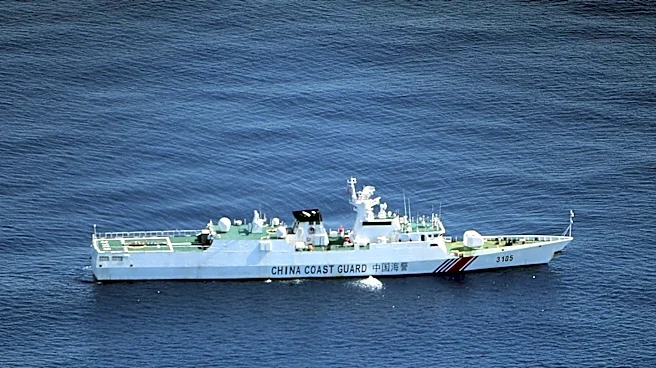
Taiwan's Coast Guard has accused China's Coast Guard of harassing shipping and attempting to exert a fictional jurisdiction with its latest patrol off Taiwan’s east coast. Taiwan's authorities reported that two Chinese ships were involved in the patrol,
prompting Taiwan to dispatch its own forces to monitor the situation. Chinese state media broadcast video of one of its ships issuing a radio message claiming law enforcement activities and offering assistance, though it did not specify the recipient. Taiwan's Coast Guard condemned these actions, stating that China's attempts to harass ships via radio communications constitute an expansion of power that violates international law, undermines regional peace, and deviates from reality. Taiwan asserts its sovereign rights and jurisdiction over the exclusive economic zone east of Taiwan, emphasizing that China has no jurisdiction over these waters. Additionally, China sent another Coast Guard ship near the Taiwan-controlled Pratas Islands, a strategically important location in the South China Sea. Taiwan's Coast Guard reported expelling Chinese Coast Guard vessels from Pratas waters 13 times this year.
Why It's Important?
This development is important as it highlights escalating tensions in the Taiwan Strait and the broader South China Sea, areas critical for international shipping and regional stability. China's increased maritime activities, including regular Coast Guard patrols, are perceived by Taiwan as practice for a potential maritime blockade, utilizing a combination of military, paramilitary, and civilian assets. Such a blockade would severely impact Taiwan's wartime supply routes from allies, particularly those originating from its east coast. The assertion of 'fictional jurisdiction' by China challenges Taiwan's sovereignty and international maritime law, potentially setting a dangerous precedent for other disputed territories. The repeated expulsions of Chinese vessels from the Pratas Islands underscore the vulnerability of these outposts and the constant pressure Taiwan faces. This situation could lead to miscalculations or accidental confrontations, with significant implications for U.S. foreign policy and its commitment to regional security, as any conflict in this area would disrupt global trade and supply chains.
What's Next?
The ongoing patrols and counter-monitoring efforts suggest a continued pattern of assertive actions by China and defensive responses by Taiwan. Taiwan is likely to maintain its vigilance and continue to challenge what it views as illegal incursions into its waters. The international community, particularly the U.S. and its allies, will closely watch these developments, as they have implications for freedom of navigation and regional stability. There may be increased diplomatic pressure on China to de-escalate, and Taiwan may seek further support from its international partners to bolster its maritime defense capabilities. The strategic importance of the Pratas Islands means that any further escalation around them could draw more significant international attention and potentially lead to a more robust response from nations concerned about China's territorial ambitions. The situation could also prompt a review of existing maritime laws and enforcement mechanisms in disputed areas.
Beyond the Headlines
Beyond the immediate naval maneuvers, this situation reflects a deeper geopolitical struggle over sovereignty and influence in the Indo-Pacific. China's actions are part of a broader strategy to assert its claims over Taiwan and the South China Sea, aiming to alter the status quo through persistent presence and legalistic arguments, even if those arguments are rejected by Taiwan and many international observers. The use of Coast Guard vessels, rather than solely military ships, allows China to project power in a gray zone, blurring the lines between law enforcement and military action, making it harder for other nations to respond without escalating the conflict. This tactic tests the resolve of Taiwan and its allies, pushing the boundaries of international norms without triggering a direct military confrontation. The long-term implication is a potential shift in regional power dynamics, where China's persistent pressure could gradually erode Taiwan's effective control over its claimed territories and maritime zones, impacting the balance of power in a critical global region.