






What's Happening?
The International Monetary Fund (IMF) has revised its economic growth forecast for Germany, projecting a growth rate of 0.7% for 2026, a slight decrease from its previous estimate of 0.8%. This adjustment comes as Germany's export-driven economy faces
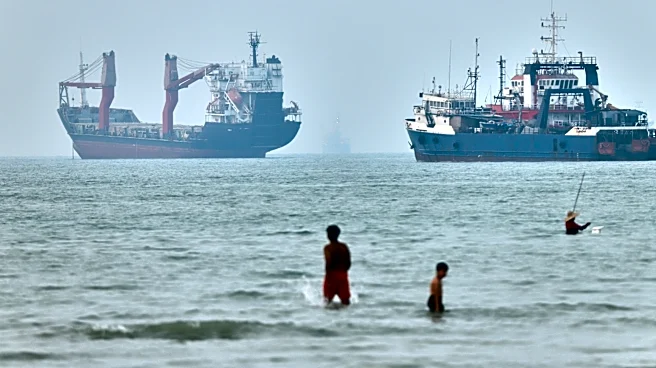
significant challenges, particularly due to rising energy prices following geopolitical tensions, including the US-Israeli conflict with Iran. The blockade of the Strait of Hormuz, a critical route for global oil and gas trade, has exacerbated these economic pressures. The IMF's outlook for 2027 also reflects a downward revision, with expected growth now at 1%, down from an earlier forecast of 1.2%. Despite these challenges, the global economic outlook remains somewhat optimistic, with the IMF predicting a global GDP growth of 3% in 2026 and an improved 3.4% in 2027.
Why It's Important?
Germany's economic performance is crucial not only for Europe but also for the global economy, given its role as a major exporter and economic powerhouse. The revised growth forecasts highlight the vulnerabilities of economies heavily reliant on exports, especially in times of geopolitical instability. The ongoing conflict and energy price volatility could have ripple effects, impacting industries reliant on German exports and potentially leading to broader economic slowdowns. Additionally, the IMF's global growth projections suggest that while some regions may experience recovery, uncertainties remain, particularly with potential renewed conflicts affecting global trade routes and energy supplies.
What's Next?
The German government and businesses may need to explore strategies to mitigate the impact of energy price fluctuations and geopolitical tensions. This could involve diversifying energy sources, enhancing energy efficiency, and strengthening trade relations with alternative markets. Policymakers might also focus on domestic economic policies to stimulate growth and reduce reliance on exports. On a global scale, diplomatic efforts to stabilize geopolitical tensions, particularly in the Middle East, could play a critical role in ensuring a more stable economic environment.