
What's Happening?
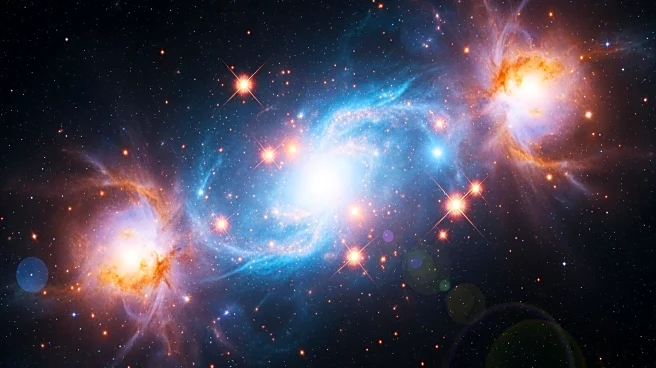
The James Webb Space Telescope (JWST) and the Hubble Space Telescope (HST) have both captured images of the Westerlund 2 nebula, located 20,000 light-years from Earth in the constellation Carina. The HST first
imaged this vibrant star cluster in 2015, marking its 25th anniversary in orbit. Recently, the JWST provided a more detailed view of the same nebula, showcasing its advanced observational capabilities. The European Space Agency (ESA) highlighted these differences by allowing viewers to compare the images using a slider tool. The JWST's images reveal hundreds of additional, dimmer stars and intricate details of the nebula's structure, including young stellar objects and their interactions with surrounding gaseous clouds.
Why It's Important?
This development underscores the significant technological advancements in space observation tools over the past decade. The JWST's ability to capture more detailed images than its predecessor, the HST, allows astronomers to study celestial phenomena with greater precision. The detailed imagery of Westerlund 2 provides insights into the formation and evolution of stars and planetary systems within massive star clusters. This can enhance our understanding of the universe's structure and the processes that govern stellar and planetary formation. The data collected could lead to new discoveries about the lifecycle of stars and the conditions necessary for planet formation.
What's Next?
Astronomers are expected to use the JWST's data to conduct in-depth studies of the Westerlund 2 nebula, focusing on the formation of brown dwarf stars and the development of planetary systems within such dense star clusters. The findings could influence future research directions and inform the design of subsequent space telescopes. Additionally, the continued comparison of images from the HST and JWST will likely drive further technological innovations in space observation, potentially leading to even more advanced telescopes in the future.
Beyond the Headlines
The ability to observe and analyze distant celestial bodies with such clarity has broader implications for our understanding of the universe. It raises questions about the potential for life in other star systems and the conditions that might support it. The technological leap represented by the JWST also highlights the importance of international collaboration in space exploration, as agencies like NASA and ESA work together to push the boundaries of human knowledge.