








What's Happening?
A recent study published in Science Advances has revealed that despite nearly seventy years of deep-sea exploration, humans have visually observed less than 0.001% of the deep seafloor. This research, led by Katherine L. C. Bell of the Ocean Discovery
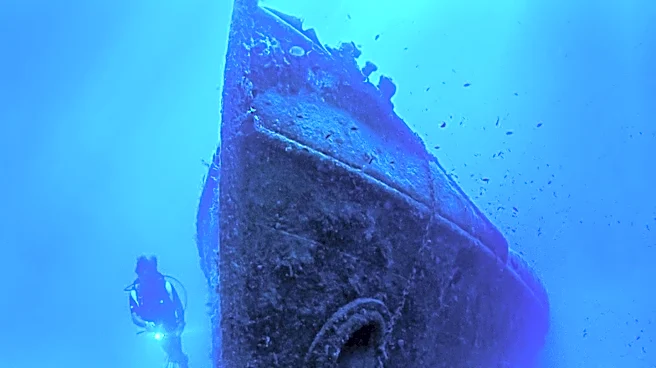
League, compiled 43,681 submersible dive records dating back to 1958. The study highlights that the area observed is roughly the size of Rhode Island, a minuscule portion compared to the vast expanse of the deep seafloor, which covers about 66% of Earth's surface. The research underscores the limited direct visual observation of the deep seabed, despite advances in mapping technologies like satellites and sonar. The study also notes that visual exploration has been geographically concentrated, with 65% of observations occurring near the United States, Japan, and New Zealand.
Why It's Important?
The findings of this study are significant as they highlight the vast unexplored areas of the deep ocean, which are crucial for understanding biodiversity, climate change, and potential commercial activities like seabed mining. The limited visual records pose challenges for assessing ecological baselines and understanding the impacts of human activities on these environments. The concentration of observations in certain regions could lead to skewed global assumptions about deep-sea habitats and species distribution. This gap in knowledge is critical as the deep ocean becomes increasingly central to debates over environmental conservation and resource exploitation.
What's Next?
The study suggests that improving access to deep-sea exploration technology and sharing data more widely could help address the current gaps in knowledge. There is a call for more inclusive participation from coastal and island nations, which have been underrepresented in deep-sea research. Additionally, leveraging industrial imagery and developing lower-cost exploration vehicles could enhance the understanding of the deep seafloor. These steps are essential for making informed decisions about the management and conservation of deep-sea environments.
Beyond the Headlines
The study raises ethical and scientific concerns about the uneven distribution of deep-sea exploration efforts. The reliance on a small number of countries for visual records could lead to biased scientific conclusions and policy decisions. Furthermore, the study emphasizes the need for transparency and collaboration in deep-sea research to ensure that all regions are adequately represented and that global environmental policies are based on comprehensive data.