




What's Happening?
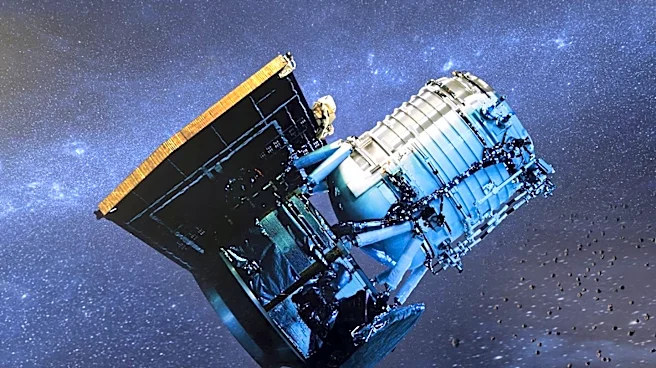
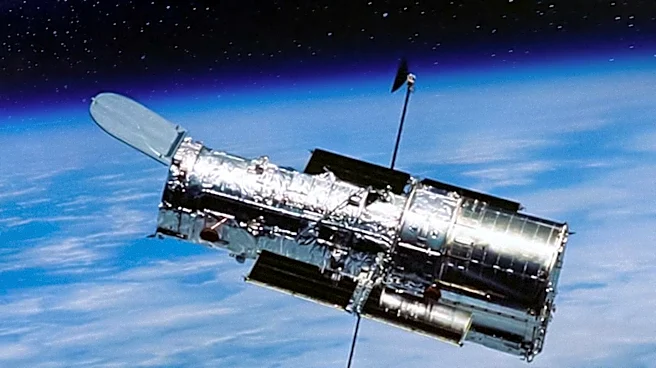
NASA has completed fueling the Nancy Grace Roman Space Telescope, marking a crucial step towards its scheduled launch in late August. The telescope, fueled with 290 gallons of hydrazine, will travel to the Sun-Earth Lagrange point 2 (L2), located about
one million miles from Earth. This position offers an optimal environment for astronomical observations. The Roman Space Telescope is designed to study thousands of exoplanets and investigate the nature of dark energy, which is believed to be causing the universe's accelerated expansion. The mission is set for a primary duration of five years, with the potential for an additional five-year extension.
Why It's Important?
The Roman Space Telescope represents a significant advancement in space exploration and astrophysics. By studying exoplanets, scientists hope to gain insights into their composition and potential habitability, contributing to the broader search for life beyond Earth. Additionally, the telescope's investigation into dark energy could provide critical data to understand the universe's expansion, potentially reshaping current cosmological models. The mission underscores NASA's commitment to advancing scientific knowledge and maintaining leadership in space exploration. The successful deployment and operation of the Roman Space Telescope could pave the way for future missions and collaborations in the field of astrophysics.
What's Next?
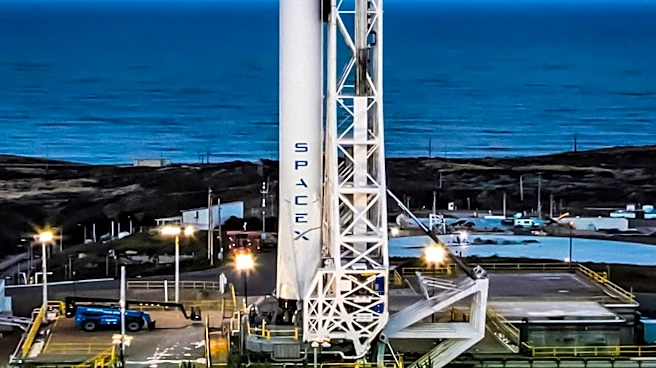
With fueling complete, NASA will proceed with final preparations for the Roman Space Telescope's launch, including attaching it to the rocket's top stage and encapsulating it within the payload fairing. The launch is scheduled for August 30 aboard a SpaceX Falcon Heavy from Kennedy Space Center. Once in orbit, the telescope will undergo a series of tests and calibrations before commencing its scientific mission. Researchers worldwide are eagerly anticipating the data that Roman will provide, which could lead to groundbreaking discoveries in exoplanetary science and cosmology.