






What's Happening?
Astronomers, utilizing archival data from NASA's Hubble Space Telescope, have identified a surprising chemical signature that indicates the white dwarf star HS 0209+0832 may host a second-generation planet. This discovery, detailed in a study published
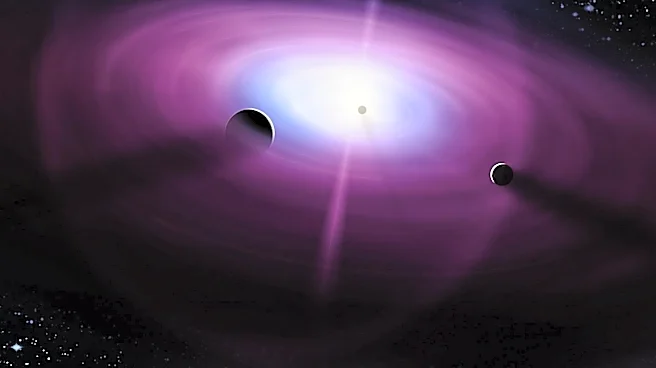
in Nature Astronomy, suggests that planets can form from material expelled during a star's death. Jamie Williams, an astronomer and lead author from the University of Warwick, revisited Hubble's 1999 observations of the star, which initially contained approximately 100 unidentified chemical features. With an updated chemical database, Williams found that the element niobium matched many of these mystery features. Niobium, along with other elements heavier than iron, is not formed through thermonuclear fusion in stellar cores but rather in the exotic conditions present during a star's demise. The research team theorizes that after the star ejected this chemically enriched material, some of it coalesced into a gas giant planet. This finding was corroborated by data from NASA’s retired FUSE (Far Ultraviolet Spectroscopic Explorer) mission, which also showed strong niobium signatures in the HS 0209+0832 system.
Why It's Important?
This discovery significantly broadens our understanding of planetary formation and the life cycles of stellar systems. Traditionally, planets are understood to form from the leftover material present during a star's birth, making them 'first-generation' planets. The identification of a potential 'second-generation' planet, formed from the remnants of a dying star, challenges this conventional view and suggests that planetary systems can be far more dynamic and resilient than previously thought. This opens new avenues for research into exoplanet formation and evolution, potentially increasing the number of environments where life could theoretically arise. The presence of niobium as a key indicator provides a novel method for detecting such planets, offering astronomers a new tool in their search for exoplanets. This research also highlights the enduring value of archival astronomical data, demonstrating that past observations can yield groundbreaking insights when re-examined with advanced analytical techniques and updated databases.
What's Next?
The research team plans to continue using the Hubble Space Telescope to explore these types of systems over the next several years. Their goal is to gather substantial data and statistics to better understand how second-generation planets form, their prevalence, and how they evolve in orbit around 'dead' stars. NASA’s TESS (Transiting Exoplanet Survey Satellite) has also observed the white dwarf for four months, detecting periodic brightness variations that suggest the candidate planet orbits at a distance of about 3.7 million miles (6 million kilometers). The team estimates this gas giant is similar in size to Jupiter and is currently losing atmosphere due to the heat from the relatively new white dwarf. This atmospheric stripping could create a comet-like tail of material that forms a disk around the white dwarf, eventually falling back onto its surface, which would explain Hubble's detection of niobium. Despite this mass loss, researchers believe the planet is likely to survive, eventually entering a stable habitable zone as the white dwarf cools.
Beyond the Headlines
The concept of second-generation planets introduces a profound shift in our cosmic narrative, suggesting that the death of a star is not necessarily an end but a potential new beginning for planetary formation. This discovery challenges the anthropocentric view of planetary systems, where our solar system's formation is often considered the norm. It implies a more complex and cyclical universe where stellar remnants can foster new worlds, potentially expanding the definition of 'habitable zones' to include regions around white dwarfs. The ethical implications of this research are subtle but significant, as it encourages a broader perspective on the potential for life beyond our current understanding. It also underscores the importance of international scientific collaboration, with the Hubble Space Telescope being a joint project between NASA and ESA, demonstrating how shared resources and expertise can lead to monumental discoveries that push the boundaries of human knowledge and inspire future generations of scientists.