
What's Happening?
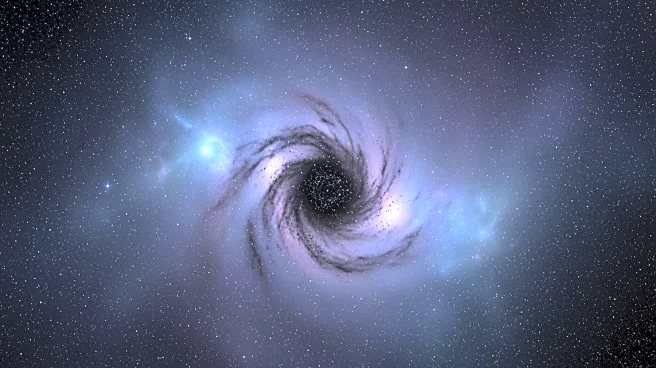
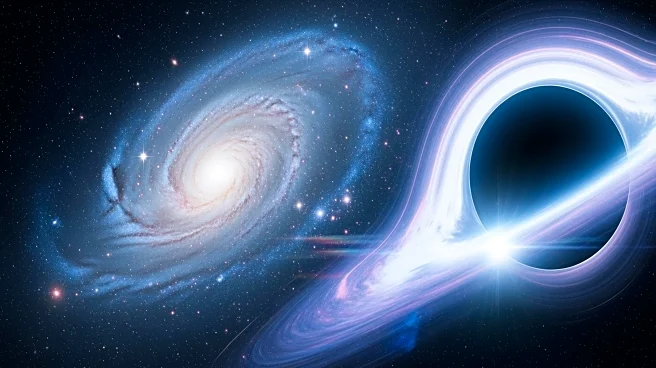
Recent research challenges the long-held belief that a supermassive black hole, known as Sagittarius A*, resides at the center of the Milky Way galaxy. Instead, scientists suggest that this central mass could be a dense clump of dark matter. This theory,
published in the Monthly Notices of the Royal Astronomical Society, posits that the dark matter is composed of fermions, subatomic particles that could form a tightly packed core. This alternative explanation arises from the observation that dark matter, which is believed to account for 85% of the universe's mass, provides the gravitational force necessary to hold galaxies together. The study indicates that a fermionic dark matter core could replicate the gravitational effects attributed to a black hole, including the orbits of fast-moving stars near the galactic center.
Why It's Important?
This new theory could significantly alter our understanding of galactic centers and the role of dark matter in the universe. If proven, it would challenge the current consensus on black holes and potentially reshape cosmological models. The implications extend to how we perceive the structure and evolution of galaxies, as well as the fundamental nature of dark matter. This could lead to new insights into the universe's composition and the forces that govern it. The research also highlights the need for further observations to confirm or refute the presence of a black hole at the Milky Way's core, which could influence future astronomical studies and technologies.
What's Next?
Future observations and studies are necessary to test this dark matter hypothesis. Astronomers will likely focus on identifying key indicators that distinguish a black hole from a dark matter core. This could involve analyzing the behavior of stars and other celestial bodies near the galactic center, as well as utilizing advanced telescopes and observational techniques. The outcome of these investigations could either reinforce the current understanding of black holes or pave the way for a new paradigm in astrophysics.