




What's Happening?
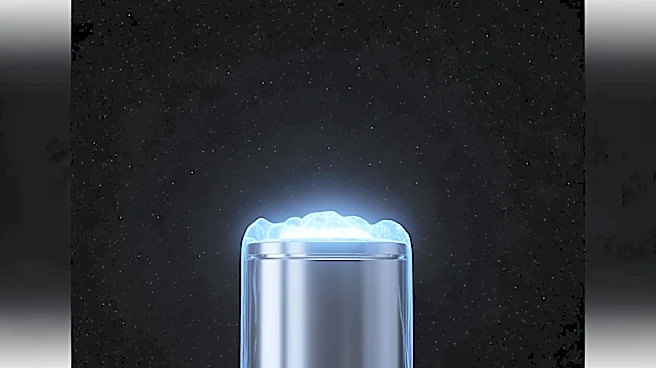
The CRESST-III collaboration has made significant advancements in the detection of sub-GeV dark matter using cryogenic detectors. The experiment utilizes a cryogenic diamond detector with a threshold of 16.8 eV to set new exclusion limits on elastic spin-independent
dark-matter-carbon interactions. This development is part of a broader effort to enhance sensitivity to light dark matter by reducing low-energy excess (LEE) backgrounds through improved module designs and advanced analysis strategies. The collaboration aims to achieve a reduction in LEE by a factor of 10 to 100, which is expected to significantly improve the experiment's sensitivity. The CRESST setup includes 288 readout channels, allowing for a comprehensive analysis of potential dark matter interactions.
Why It's Important?
The advancements in the CRESST experiment are crucial for the field of particle physics, particularly in the search for dark matter, which remains one of the most elusive components of the universe. By improving the sensitivity of detectors to sub-GeV dark matter, the CRESST collaboration is paving the way for potential discoveries that could reshape our understanding of the universe's composition. The ability to detect lighter dark matter particles could lead to breakthroughs in theoretical physics and provide insights into the fundamental forces and particles that govern the cosmos. This research also has implications for the development of new technologies in cryogenics and detector design.
What's Next?
The CRESST collaboration plans to continue refining their detection methods and reducing background noise to further enhance sensitivity. Future upgrades to the CRESST setup will include the operation of a larger number of detectors, which will improve the experiment's ability to detect spin-dependent interactions and explore new regions of dark matter mass ranges. The collaboration is also considering the potential for incorporating solar axion searches into their research, which could open new avenues for understanding dark matter and related phenomena.
Beyond the Headlines
The CRESST experiment's focus on reducing low-energy excess backgrounds highlights the importance of precision in experimental physics. The collaboration's efforts to improve detector sensitivity and reduce noise could have broader applications in other areas of scientific research, including medical imaging and materials science. Additionally, the experiment's success in detecting single photons in a cryogenic detector underscores the potential for cryogenic technology to revolutionize various fields by enabling more precise measurements at extremely low temperatures.