








What's Happening?
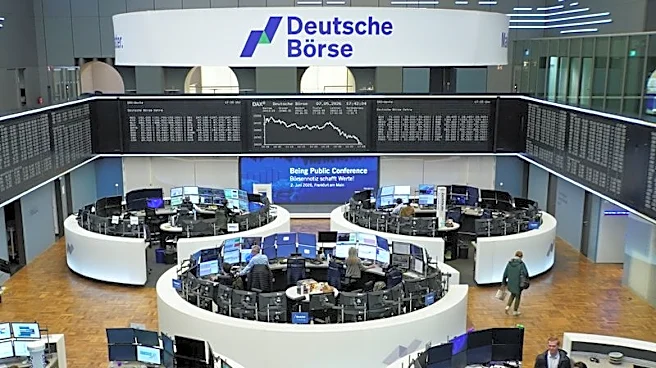
European stock markets closed lower following President Trump's threat to impose higher tariffs on the European Union if a trade deal is not implemented by July 4, 2026. The pan-European Stoxx 600 index fell by 0.8%, with major markets in London, Paris,
Frankfurt, and Milan all experiencing declines. The threat of increased tariffs comes amid ongoing trade tensions and a recent Supreme Court ruling against Trump's reciprocal tariffs regime. Additionally, the UK is in the midst of local elections, with early results indicating significant losses for the Labour and Conservative parties, while smaller parties like Reform UK and the Green Party are expected to gain ground.
Why It's Important?
The potential for higher tariffs could have a significant impact on European economies, particularly in sectors heavily reliant on exports to the U.S. The uncertainty surrounding the trade deal adds to existing economic pressures, including those from geopolitical tensions and domestic political challenges. In the UK, the election results could lead to shifts in political power and policy direction, affecting both domestic and international economic strategies. The combination of these factors contributes to a volatile market environment, with investors closely watching for developments that could influence economic stability.
What's Next?
As the July 4 deadline approaches, both the U.S. and EU will need to navigate complex negotiations to avoid a trade escalation. The outcome of the UK elections could also influence future trade and economic policies, particularly if there are significant changes in political leadership. Market participants will be monitoring these developments, as they could have far-reaching implications for global trade and economic growth.