
What's Happening?
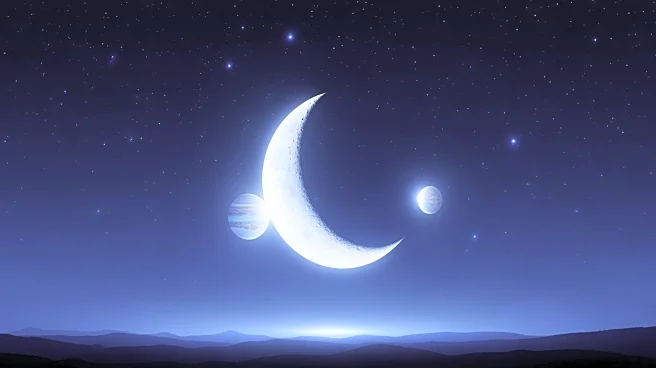
In February 2026, skywatchers in the U.S. will have the opportunity to observe several planets in the night sky, with Jupiter and Mercury being particularly prominent. Jupiter, the largest planet in the solar
system, will be visible high in the east-southeast sky at nightfall, providing excellent viewing conditions throughout the month. Meanwhile, Mercury will be visible in the west-southwest sky, offering its finest evening apparition starting February 6. This period will last for about three weeks, during which Mercury will be visible approximately 45 minutes after sunset. Venus, although challenging to spot at the beginning of the month, will become more visible as February progresses. Saturn, on the other hand, will be increasingly difficult to see due to its low altitude and the bright twilight. Mars will not be visible as it remains too close to the sun's glare.
Why It's Important?
These astronomical events provide a unique opportunity for both amateur and professional astronomers to observe and study the planets. Jupiter's visibility allows for detailed observation of its cloud patterns and moons, which can contribute to ongoing research and public interest in astronomy. Mercury's appearance is significant as it offers a rare chance to view the planet during its greatest elongation, a phenomenon that will not be matched until 2039. Such events can inspire educational activities and public engagement with science, fostering a greater appreciation for space exploration and the natural world. Additionally, these celestial occurrences can boost local economies through increased tourism and related activities.
What's Next?
As February progresses, Venus will become more visible, providing another highlight for skywatchers. The visibility of these planets will continue to change, offering different viewing opportunities throughout the month. Astronomers and enthusiasts will likely continue to monitor these changes, sharing observations and insights with the broader community. Educational institutions and observatories may organize events and viewing sessions to capitalize on public interest, further promoting science education and awareness.