





What's Happening?
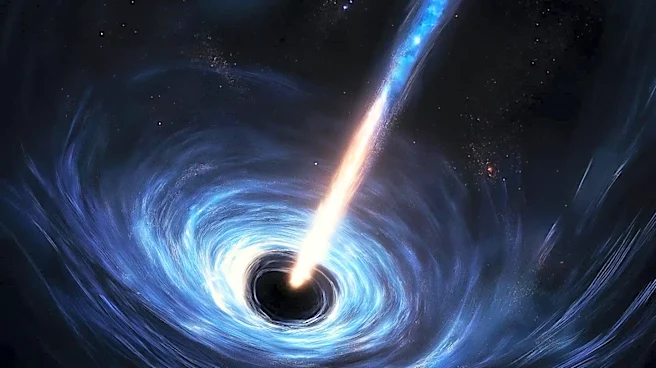
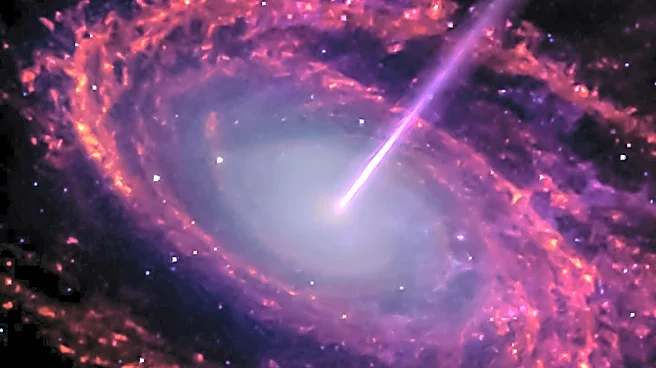
New research led by astronomers Sanchayeeta Borthakur of Arizona State University (ASU) and Namrata Roy, now at the Raman Research Institute (RRI), provides evidence that narrow jets of heated plasma emitted by supermassive black holes can significantly
impact gas far beyond a galaxy's visible edge. These jets, which are streams of hot, fast-moving plasma, disrupt the circumgalactic medium (CGM) – a vast envelope of gas surrounding galaxies that is crucial for star formation. By combining observations from hundreds of galaxies using data from the Dark Energy Spectroscopic Instrument (DESI) survey and radio jet measurements from the LOFAR Two-meter Sky Survey (LoTSS), the team found that the glow from ionized hydrogen gas (H-alpha) is particularly strong along the paths of these radio jets. This indicates that the jets do not affect the surrounding gas uniformly but rather leave a distinct impression, causing the gas to become ionized and shine primarily along their trajectory. The glow is brightest near the galaxy where the jet first interacts with the CGM and further out where the jet releases most of its energy.
Why It's Important?
This discovery is crucial for understanding how galaxies evolve and why they don't form more stars despite abundant gas. The findings offer some of the clearest evidence to date of how a black hole, despite its relatively small size, can influence a galaxy far beyond its central region. By heating, stirring, and disturbing the gas throughout the CGM, these powerful jets can prevent the gas from cooling down and falling inward to fuel new star formation. This mechanism acts as a brake on a galaxy's growth, altering its fate and making it less active in producing stars. This implies that black holes are not merely passive entities at the galactic center but actively shape their environment, which in turn dictates the long-term evolution and star-forming capabilities of the entire galaxy. The research highlights the intricate connection between supermassive black holes and the broader galactic ecosystem.
What's Next?
This work opens new avenues for exploring the complex relationship between supermassive black holes and galaxy evolution. The directional nature of the observed signal, which was previously missed by studies assuming uniform gas distribution, suggests that future research will need to specifically look along jet directions to fully understand their impact. The study also provides astronomers and theorists with a new method to test how black hole jets affect galaxies, potentially leading to refined models of galactic development. Further investigations will likely focus on the intricacies of how energy from active black holes reaches such vast distances and how it changes along the way. The use of large optical and radio surveys will continue to be vital in uncovering subtle behaviors of galaxies that would otherwise remain undetected.
Beyond the Headlines
The profound implication of this research extends to our understanding of cosmic structures and the conditions necessary for life. If black holes actively regulate star formation across entire galaxies, they indirectly influence the availability of planetary systems and, consequently, the potential for life to emerge. The 'ant leaving its impression hundreds or thousands of kilometers away' analogy used by the researchers underscores the disproportionate influence of these cosmic giants. This challenges the traditional view of black holes as isolated gravitational wells, instead portraying them as integral, dynamic components that sculpt the universe on a grand scale. The findings also highlight the power of combining vast datasets from surveys like DESI and LoTSS to reveal subtle but critical phenomena in astrophysics, pushing the boundaries of what can be observed and understood about the cosmos.