







What's Happening?
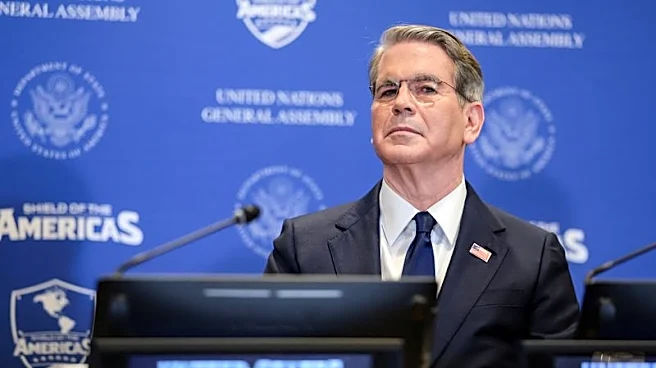
Treasury Secretary Scott Bessent has announced that a proposed U.S.-China dialogue on advanced artificial intelligence (AI) risks is expected to advance at the upcoming Asia-Pacific Economic Cooperation (APEC) summit in Shenzhen, scheduled for November
18-19. Bessent, who will join President Trump at the summit, stated that the dialogue aims for coordination between the two nations on managing risks associated with advanced AI. The proposed discussions would cover critical areas such as methods for assessing and testing advanced AI models, ensuring human oversight of these systems, and establishing a direct incident-alert channel. This channel would allow both governments to notify each other about serious AI-related incidents, a measure reportedly agreed upon during a White House meeting in September 2026. Bessent emphasized that these discussions would focus on what he termed 'superintelligence' (SI), reflecting an effort to address shared AI risks amidst ongoing technological competition between the U.S. and China. This will be the third meeting between President Trump and Chinese President Xi Jinping this year.
Why It's Important?
The advancement of a U.S.-China AI dialogue at the APEC summit is highly significant for global technology governance and international relations. As the two leading nations in AI development, their cooperation on managing advanced AI risks could set a precedent for global standards and responsible AI development. For the U.S., engaging in such a dialogue allows for the potential to influence international norms, mitigate unforeseen risks from rapidly evolving AI technologies, and ensure that competition does not lead to destabilizing outcomes. The establishment of an incident-alert channel is particularly crucial, as it could prevent misunderstandings or escalations in the event of AI-related malfunctions or misuse. This initiative reflects a broader U.S. administration strategy to reduce risky dependencies on China while maintaining essential diplomatic and technological ties. The dialogue could also impact the development of future AI regulations and ethical guidelines, influencing U.S. industries involved in AI research, development, and deployment by shaping the global operational environment for these technologies.
What's Next?
The APEC summit in Shenzhen is slated as the next crucial step for the U.S.-China superintelligence dialogue, with further discussions expected to occur on the sidelines of the leaders' meeting. Should the dialogue advance as anticipated, the next phase would likely involve detailed technical discussions between experts from both countries to flesh out the specifics of advanced-model testing protocols, human oversight mechanisms, and the operational framework for the incident-alert channel. The outcomes of these discussions could lead to the establishment of joint working groups or regular bilateral meetings dedicated to AI risk management. The progress made at APEC will also be closely watched by other nations and international organizations, potentially influencing broader multilateral efforts to govern AI. The ongoing engagement between President Trump and Chinese President Xi Jinping on this matter suggests a sustained commitment to addressing these complex technological challenges, with future meetings likely to build upon any agreements reached in Shenzhen.
Beyond the Headlines
The proposed U.S.-China AI dialogue delves into profound ethical and strategic implications beyond immediate risk management. The focus on 'superintelligence' highlights the long-term concerns about AI's potential for autonomous decision-making and its societal impact, raising questions about control, accountability, and the very definition of human agency in an AI-driven future. This dialogue also reflects a delicate balance in U.S. foreign policy: competing for technological leadership while seeking cooperation on existential risks. The establishment of an incident-alert channel, while practical, also implicitly acknowledges the potential for AI systems to cause significant, unforeseen disruptions, underscoring the need for robust international communication protocols. Furthermore, the discussions could inadvertently shape the global AI arms race, as both nations seek to understand and potentially influence each other's AI capabilities. The ethical frameworks developed through this dialogue could influence global norms on AI ethics, data governance, and the responsible development of advanced technologies, impacting legal systems and societal values worldwide.