







What's Happening?
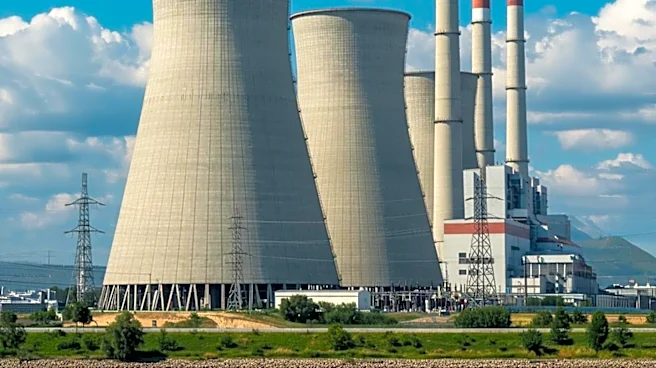
The nuclear energy sector is undergoing a renaissance, marked by a convergence of scientific, technological, and economic factors. Over the past decade, there has been a significant resurgence in nuclear science and technology. Recently, developers of five
different reactor models achieved 'initial criticalities,' demonstrating the physics of their designs through low-power chain reactions. Advanced reactors are currently under construction in Wyoming, Idaho, and Tennessee, with another planned for Texas. Several companies involved in these projects have raised over $1 billion in start-up funding, and a dozen advanced reactor companies are now trading on Wall Street. States are also actively supporting the industry by establishing offices to assist nuclear companies and allocating funds. The White House has set goals for nuclear expansion, viewing it as an investment in national security. Even states like California and those in New England, which previously had moratoria on new reactor construction, are now considering nuclear power in their energy plans.
Why It's Important?
This resurgence in nuclear energy is critical for addressing growing energy demands and global climate change concerns. Nuclear power offers a carbon-free energy source, which is essential for reducing greenhouse gas emissions and achieving climate goals. The development of new, more efficient, and safer reactor designs could provide a stable and reliable power supply, reducing reliance on fossil fuels. For the U.S., this could enhance energy independence and create numerous high-tech jobs in research, development, and construction. The increased investment and state-level support signal a shift in policy and public perception towards nuclear energy, recognizing its potential benefits. However, challenges remain, including the need for a robust supply chain for fuel and components, and the training of a new generation of nuclear engineers and technicians to support this expansion.
What's Next?
The nuclear energy sector will likely see continued innovation and investment in advanced reactor technologies. Efforts will focus on moving new designs from commercial prototypes to full-scale commercial production. Anticipated bottlenecks, such as workforce development and supply chain issues, are being addressed through initiatives like new training programs in Tennessee and New York, and Department of Energy efforts to strengthen the supply chain. There will also be a push for improved coordination between government and industry to promote the export of nuclear energy hardware, which could help achieve economies of scale and enhance American influence globally. While the path forward may not be entirely smooth, with potential practical problems and industrial mishaps in first-of-a-kind projects, the overall trend points towards significant growth and transformation in the nuclear energy landscape.
Beyond the Headlines
The renewed embrace of nuclear energy has deeper implications beyond immediate energy needs. It represents a significant shift in environmental policy and public discourse, moving away from past anxieties about nuclear safety and waste towards a recognition of its role in a sustainable energy future. This shift could influence how other complex technological solutions to climate change are perceived and adopted. Ethically, it raises questions about long-term waste management and the equitable distribution of nuclear facilities. Culturally, it could foster a new generation of scientific and engineering talent, revitalizing STEM fields. The 'syzygy' of factors driving this renaissance suggests a broader societal recognition of the urgency of climate action and the need for diverse, robust energy solutions, potentially setting a precedent for how large-scale infrastructure projects are approached in the future.