

What's Happening?
U.S. Representative Emanuel Cleaver II, currently serving his tenth term representing Missouri’s 5th Congressional District, has secured a $5 million federal grant for the 'Reconnecting the East Side' project in Kansas City. This initiative aims to address
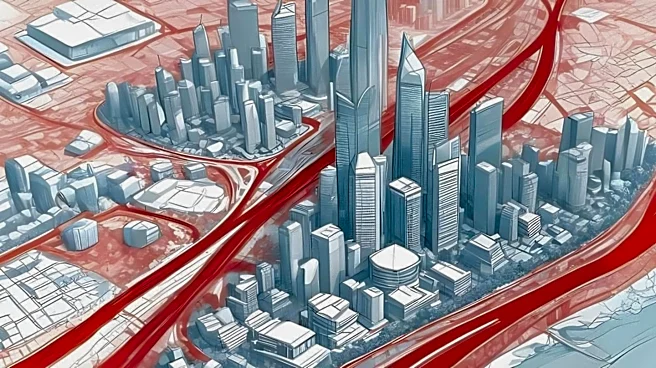
the historical harm caused by the construction of Bruce R. Watkins Drive (formerly U.S. Highway 71). The highway, completed in 2001, was initially designed to connect fast-growing suburbs to downtown but effectively isolated a significant portion of the Black community from the Prospect Avenue commercial corridor and other city areas. The project is currently in its first phase, focusing on planning and environmental linkages, which includes extensive community engagement. Options under consideration for the thoroughfare include placing it below current street level, reverting it to a pre-highway street design, or converting it into a parkway with landscaping and narrower travel lanes. The parkway alternative, which integrates overpasses or underpasses at key intersections to improve safety and air quality, has garnered significant community support.
Why It's Important?
This project is important because it directly addresses long-standing issues of urban planning and racial equity in Kansas City. The original construction of Bruce R. Watkins Drive, despite being renamed to honor Bruce R. Watkins, a prominent Black leader who warned against its divisive impact, created a physical barrier that contributed to the economic and social isolation of the East Side. The $5 million federal grant signifies a commitment to rectifying these historical injustices and fostering community revitalization. By prioritizing environmental improvements, safety enhancements, and economic development, particularly along Prospect Avenue, the project seeks to undo decades of negative consequences. The focus on community engagement ensures that the solutions are tailored to the needs and desires of the affected residents, potentially serving as a model for other cities grappling with similar legacies of urban infrastructure development that disproportionately impacted marginalized communities. The project aims to improve air quality by reducing stop-and-go traffic and enhance safety on one of Kansas City's most dangerous roadways.
What's Next?
The 'Reconnecting the East Side' project is currently in its initial phase, which involves a planning and environmental linkages study and substantial community engagement. Planners have conducted four summits and approximately 150 other community engagements to gather input on desired changes along U.S. 71 and in the surrounding communities. The next steps will involve evaluating the various alternatives, such as placing the thoroughfare below street level, reverting it to a pre-highway street, or converting it into a parkway. The parkway alternative, which includes features like landscaping, narrower travel lanes, and overpasses/underpasses at 55th Street, 59th Street, and Gregory Boulevard, has shown strong community preference. The project will also continue to prioritize building economic opportunities on the East Side, especially along Prospect Avenue, and consider future additions like public transportation in the middle of the roadway. The Kansas City Public Library will host a panel discussion titled 'Past, Present, Future of Bruce R. Watkins Drive' to further engage the public.
Beyond the Headlines
The 'Reconnecting the East Side' project delves into the deeper implications of urban infrastructure on social equity and community well-being. The historical context reveals how seemingly neutral infrastructure decisions can perpetuate systemic inequalities, as the initial routing of U.S. Highway 71 through predominantly Black neighborhoods was seen by critics as a victory for affluent white residents over disenfranchised Black communities. The NAACP's 1973 federal discrimination lawsuit and the subsequent 1985 consent decree highlight the legal and ethical battles fought to mitigate the highway's impact. This project represents a contemporary effort to not only physically reconnect communities but also to heal historical wounds and address the long-term economic and social disparities created by past planning decisions. It underscores the importance of inclusive urban planning that considers the human and social costs of development, aiming to foster a more equitable and connected urban landscape for all residents.