

What's Happening?
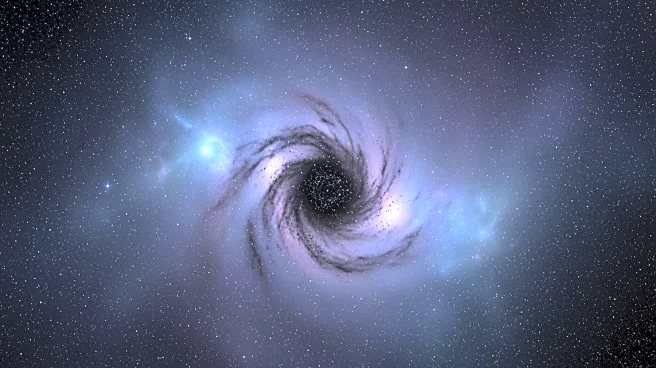
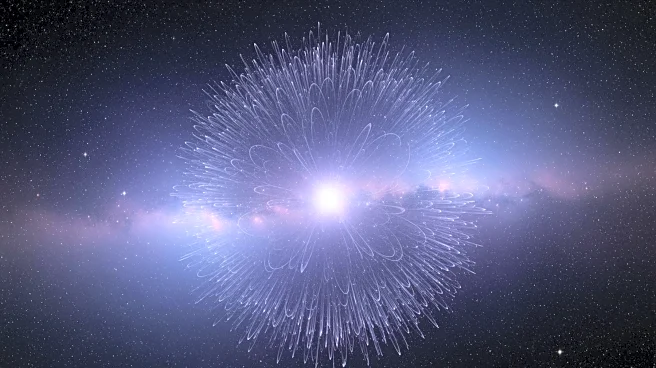
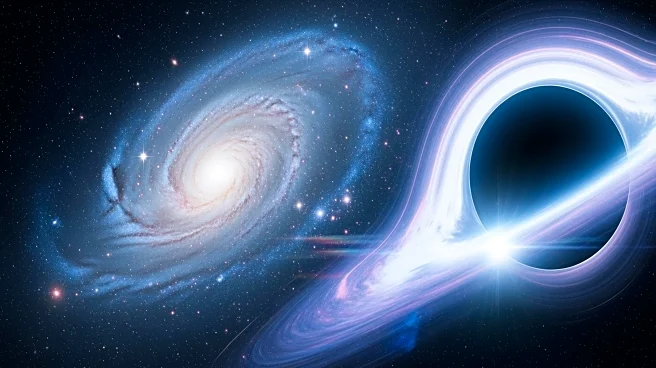
Recent research suggests that the center of the Milky Way may not be dominated by a supermassive black hole, as traditionally believed, but rather by a dense core of dark matter. This theory is based on observations indicating that stars at the galaxy's
outskirts slow down, a phenomenon known as Keplerian decline. The study, published in the Monthly Notices of the Royal Astronomical Society, proposes that the gravitational effects of a dark matter core could explain these observations, challenging the long-held view of a supermassive black hole at the galactic center.
Why It's Important?
This new theory could significantly alter our understanding of galactic structures and the role of dark matter in the universe. If dark matter cores are indeed at the center of galaxies, it could reshape models of galaxy formation and evolution. This has implications for cosmology and astrophysics, potentially affecting how scientists study and interpret the dynamics of galaxies. The findings could also influence future research directions and the development of new technologies to observe and measure dark matter.
What's Next?
Further observations and studies are needed to validate this theory and explore its implications. Researchers may focus on gathering more data on the gravitational effects at the Milky Way's center and comparing them with other galaxies. Future advancements in telescope technology could provide more detailed insights into the presence and behavior of dark matter cores, potentially leading to a paradigm shift in our understanding of the universe.