





What's Happening?
A two-year study conducted by Dr. Lukas Schuster at RMIT University has demonstrated that floating wetland pods, covered with native flora, can substantially decrease greenhouse gas emissions from wastewater treatment lagoons. The study, published in the
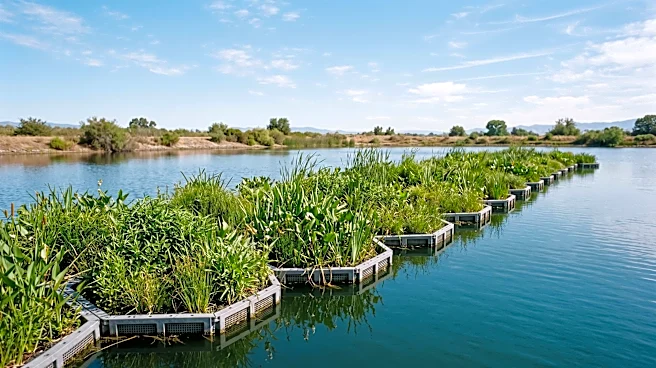
Journal of Environmental Management, found that these nature-based solutions reduced CO2 emissions by up to 36%, methane by up to 66%, and nitrous oxide by 18%. The wetland pods feature plants whose roots extend into the wastewater, supporting microbial communities that are crucial for emission reduction. This research builds upon existing knowledge that floating wetlands can effectively lower nutrient loads and remove pollutants from water. The trial involved a floating wetland approximately the size of one-and-a-half tennis courts within the Westernport Water wastewater lagoon on Victoria’s Phillip Island, covering about 7% of the water surface. A control channel without a wetland was also used for comparison.
Why It's Important?
This development is important for the U.S. as it offers a cost-effective and environmentally friendly solution to a significant source of greenhouse gas emissions. Wastewater treatment plants are major contributors to these emissions, and traditional methods for reduction can be expensive and complex. The ability to retrofit existing open-water lagoons with floating wetlands provides a scalable and accessible option for municipalities across the U.S. to meet environmental targets. By reducing CO2, methane, and nitrous oxide, these pods can help states and cities contribute to national climate goals and improve local air quality. Furthermore, the improved water quality resulting from these wetlands can benefit aquatic ecosystems and potentially reduce the need for more intensive chemical treatments, leading to healthier waterways and reduced operational costs for treatment facilities. The simplicity of the solution also makes it appealing for broader adoption, potentially creating new opportunities for ecological engineering and green infrastructure development.
What's Next?
Following the successful two-year study, RMIT researchers are now expanding their trials of floating wetlands to farm dams along Victoria’s Bass Coast, in collaboration with Melbourne Water and the Bass Coast Landcare Network. This next phase aims to assess the effectiveness of these wetlands in reducing emissions, such as methane, from water polluted by livestock faeces. If these preliminary projects yield positive results, there is potential for farmers to implement DIY versions of floating wetlands using readily available materials like coconut coir, pool noodles, and native plants. Dr. Lukas Schuster hopes that water corporations globally, including those in the U.S., will increasingly adopt this natural solution. The focus will be on encouraging more studies and greater uptake of this technology, particularly given its cost-effectiveness compared to upgrading entire treatment facilities. The long-term goal is to transition towards more sustainable and durable materials for the pods, ensuring their continued environmental benefit.
Beyond the Headlines
The broader implications of this research extend beyond immediate emission reductions. The adoption of floating wetlands represents a shift towards nature-based solutions in infrastructure, highlighting the potential for ecological engineering to address complex environmental challenges. This approach not only tackles greenhouse gas emissions but also enhances biodiversity by attracting birds and other wildlife, transforming utilitarian wastewater facilities into more integrated ecological systems. The concept of 'green infrastructure' could gain further traction, influencing urban planning and environmental policy to prioritize solutions that offer multiple co-benefits. Ethically, this method promotes a more harmonious relationship with natural processes, moving away from purely technological fixes that might have unforeseen consequences. Culturally, it could foster greater public appreciation for wetlands and their ecological services, encouraging community engagement in environmental stewardship. The scalability and low-cost nature of this solution also make it particularly relevant for developing regions and communities with limited resources, offering a pathway to sustainable wastewater management worldwide.