
What's Happening?
Researchers have developed a near-quantum-limited diamond maser amplifier that operates at millikelvin temperatures. This technology is crucial for current microwave quantum technologies, which require
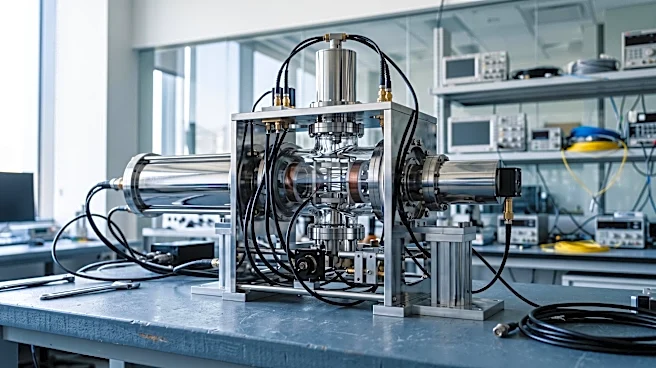
the amplification of weak signals with minimal added noise. The diamond sample used in this work was synthesized using the temperature gradient method under high-pressure and high-temperature conditions, followed by electron irradiation and annealing to create specific concentrations of P1 centers and negatively charged nitrogen-vacancy (NV-) centers. The device utilizes a loop-gap resonator, and its performance was characterized by measuring maser noise using a Y-factor method with a calibrated noise source. The team modeled the dynamics of the diamond maser amplifier using semiclassical rate equations, considering an eight-energy-level system. This research demonstrates a significant step towards achieving highly sensitive amplification necessary for advanced quantum computing and communication systems.
Why It's Important?
The development of a near-quantum-limited maser amplifier is a critical advancement for the field of quantum technology. Quantum computing and communication systems rely on the ability to detect and amplify extremely weak microwave signals without introducing significant noise, which can corrupt delicate quantum information. Traditional amplifiers often add thermal noise, limiting the sensitivity of quantum measurements. By operating at millikelvin temperatures and achieving near-quantum-limited performance, this diamond maser amplifier minimizes such noise, enabling more accurate and reliable quantum operations. This breakthrough could accelerate the development of practical quantum computers, enhance the sensitivity of radio astronomy, and improve the performance of medical imaging techniques that utilize microwave frequencies. The use of diamond as the active material also highlights its potential as a robust platform for quantum devices, leveraging its unique spin properties.
What's Next?
The researchers aim to further refine the diamond maser amplifier, potentially exploring ways to increase its operating temperature while maintaining quantum-limited performance. Future work will likely involve integrating this amplifier into more complex quantum circuits and systems to demonstrate its utility in real-world quantum applications. There will also be efforts to optimize the diamond material properties and resonator design to enhance gain and reduce noise even further. The applicability of quantum-Langevin equations to describe the noise in this maser amplifier system is currently under investigation and will be reported in future studies. Continued research in this area could lead to the commercialization of highly sensitive, low-noise amplifiers, impacting various high-tech industries.
Beyond the Headlines
This research not only pushes the boundaries of microwave amplification but also underscores the growing importance of materials science in quantum technology. The precise engineering of diamond's atomic structure to create specific spin centers is fundamental to the maser's operation, illustrating how control at the atomic level can unlock new technological capabilities. The achievement of near-quantum-limited performance touches upon the fundamental limits of measurement imposed by quantum mechanics, highlighting the ongoing quest to harness quantum phenomena for practical applications. This work could also inspire further exploration into other solid-state materials for quantum amplification, potentially leading to a new generation of quantum devices with unprecedented sensitivity and efficiency. The interdisciplinary nature of this research, combining condensed matter physics, quantum mechanics, and materials engineering, exemplifies the collaborative approach required for advancements in cutting-edge scientific fields.