








What's Happening?
The University of Utah's John and Marcia Price Department of Engineering has been awarded a $2.4 million R01 grant from the National Institutes of Health (NIH)'s National Eye Institute. This four-year grant will fund research led by Jungkyu “Jay” Kim,
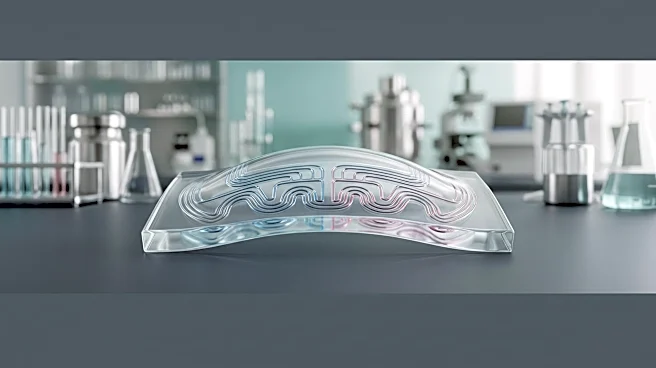
PhD, focusing on keratoconus, a progressive eye disease that causes the cornea to thin and bulge, potentially leading to blindness. Dr. Kim's team will utilize their innovative "cornea-on-a-chip" technology to investigate the progression of keratoconus. This biomedical chip allows researchers to simulate the curvature of the cornea and observe how cells respond to mechanical stress, offering a more accurate, non-animal model for studying eye diseases. The research aims to test the hypothesis that a feedback loop, initiated by the cornea's changing shape, drives the disease's progression, leading to cellular damage and tissue thinning.
Why It's Important?
This NIH grant represents a significant advancement in the study of keratoconus, a condition that affects a substantial number of individuals and is a leading cause of cornea transplant surgery worldwide. The use of the "cornea-on-a-chip" technology is particularly important as it offers a novel approach to understanding disease mechanisms without relying on animal models, which often do not accurately replicate human eye conditions. By identifying the molecular pathways involved in keratoconus progression, researchers can develop targeted drug therapies. This could lead to new treatments that intervene before the disease becomes severe, potentially reducing the need for invasive procedures like cornea transplants. The research also aligns with the FDA Modernization Act's interest in "New Approach Methodologies," promoting human-based laboratory models for drug development and disease study, which could accelerate discoveries and improve treatment outcomes for patients.
What's Next?
Over the next four years, Dr. Kim's team will focus on two primary research questions. First, they will investigate the precise mechanisms by which mechanical stress from corneal curvature leads to cellular damage and how this damage spreads. This involves determining the critical curvature at which ordinary stress becomes damaging and identifying points where the disease cycle can be interrupted. Second, the researchers will use the insights gained to test potential drug candidates on the "cornea-on-a-chip" model. These drugs will be evaluated for their ability to block the identified molecular pathways, both before the cornea steepens and after damage has begun. The findings from this research are expected to inform the development of new therapeutic strategies for keratoconus, potentially leading to clinical trials for promising drug compounds in the future. The project also involves collaboration with the Moran Eye Center, which will provide corneal tissue from keratoconus patients for further study.
Beyond the Headlines
The development and application of the "cornea-on-a-chip" technology signify a broader shift in medical research towards more sophisticated in vitro models. This approach not only offers ethical advantages by reducing the reliance on animal testing but also provides more physiologically relevant data for human diseases. The success of this project could pave the way for similar chip-based models to study other complex human conditions, accelerating drug discovery and personalized medicine. Furthermore, the research into keratoconus highlights the intricate relationship between mechanical forces and cellular biology in disease development. Understanding how physical stress can trigger and perpetuate disease processes could have implications beyond ophthalmology, influencing research in fields such as tissue engineering and regenerative medicine. This grant underscores the NIH's commitment to funding innovative research that promises to translate into tangible benefits for patient health.